 Rachel Sadon
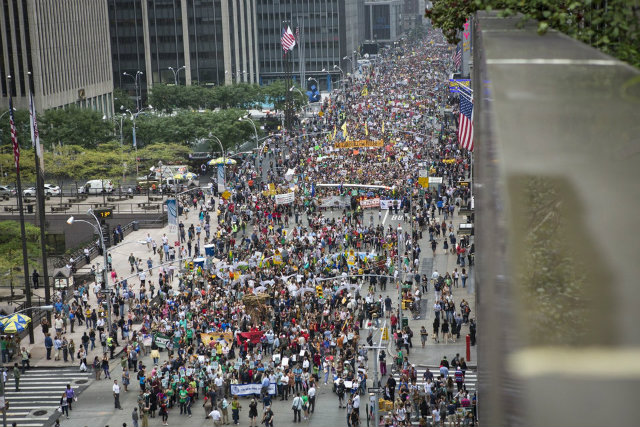 An estimated 400,000 people attended the 2014 People’s Climate March in New York City. (Photo by Jessica Lehrman)
After drawing 400,000 people to the streets of Manhattan in 2014 to advocate for action on climate change, the People’s Climate Movement is planning a massive mobilization on the National Mall on April 29—Donald Trump’s 99th day in office.
Organizing for the march was underway well before the results of the election, with the hope and general expectation that the coalition would be pushing Hillary Clinton to the left on climate issues. Instead, environmentalists are bracing for a much different fight.
“We need to save the progress we’ve made,” says Paul Getsos, the national coordinator for the People’s Climate Movement. “Were working to preserve our wins and move forward a proactive agenda as much as we can.”
If the past few days are any indication, they’ll have their work cut out for them, with executive actions to advance the Keystone and Dakota Access pipelines, a gag order on the Environmental Protection Agency, the deletion of the White House’s climate change website and reports that the administration has ordered the EPA to remove its own climate change page, and much more expected in the weeks to come.
Trump recently described himself as “to a large extent, an environmentalist” before going on to say that regulations are “out of control.” His nominee to lead the EPA is a climate change denier who has sued the agency 13 times.
“We were going to show up on April 29 to tell the next president, whoever it was, to tell them we need a big bold plan” to address climate change, Getsos says. “I think our messaging and our work is going to be bigger and bolder now.”
The National Park Service confirmed that organizers have been in touch but a permit application has not yet been filed.
The Women’s March on Washington appears to have marked the dawn of another era of massive mobilizations in the nation’s capital. In addition to the climate march, efforts are also underway to plan a Scientists’ March on Washington, an immigrants march on April 8, and a Tax Day march on April 15.
“It’s a little hard to say this close out” if there will be a rise in demonstrations, says NPS spokesman Mike Litterst. “But certainly based on the Women’s March and then an inquiry for another march coming up in a few months theoretically, it is certainly something to keep an eye on going forward.”
For events that involve heavy foot traffic on the Mall, NPS will continue to deploy panels to protect the newly restored turf, as they did during the past two inaugurations and HBO’s Concert for Valor.
The scale of the Women’s March appears to have rattled Donald Trump into making a series of unforced errors provable falsehoods, including claiming record-breaking inauguration numbers and widespread voter fraud (not to mention his press secretary outlandishly insisting this was the first time protective panels were deployed).
“Faced with a lackluster inauguration and mass protests, President Trump had a bona fide meltdown and drove his staff to make serious errors, immediately undermining his administration. This isn’t just cause for schadenfreude; it is an important revelation: constant, high-profile criticism works. Protest works,” argues Slate’s Jamelle Bouie.
Much of the success of the Women’s March has been attributed to the broad coalition that the organizers brought together—linking women’s rights with climate change, race, immigration, worker’s rights, and so many other issues. “It was phenomenal and it really built off the energy and desire for people to move to action,” Getsos says. “It was so powerful because it was rooted in a gender, race, and economic analysis.”
The big-tent is also the guiding philosophy of the People’s Climate Movement, which brought together hundreds of organizations that don’t typically work together for the 2014 march. “We had all these people, this amazing moment, we thought ‘let’s not shut it down,'” says Getsos, about the efforts to continue advocacy efforts together. “We wanted to mobilize to make the climate agenda bigger and broader and rooted in racial and economic justice.”
Now there are more than 30 groups on the coalition’s steering committee, spanning traditional environmentalists like the Sierra Club and the Union of Concerned Scientists to the NAACP, Hip Hop Caucus, and SEIU.
They are organizing events through Trump’s first 100 days, culminating in a show of unity on the National Mall at the end of April. “We’re building a movement,” Getsos says. “The march is not the goal—the march is a way to build the movement.”