You know it as one of the city’s most vibrant cultural hubs, humming at all hours with office workers and diplomats and tourists and nightclub goers. That makes Dupont Circle one of DC’s signature neighborhoods, a beacon of internationalism even in a famously international city. But there’s more below the surface of the circle—in a few cases, quite literally.
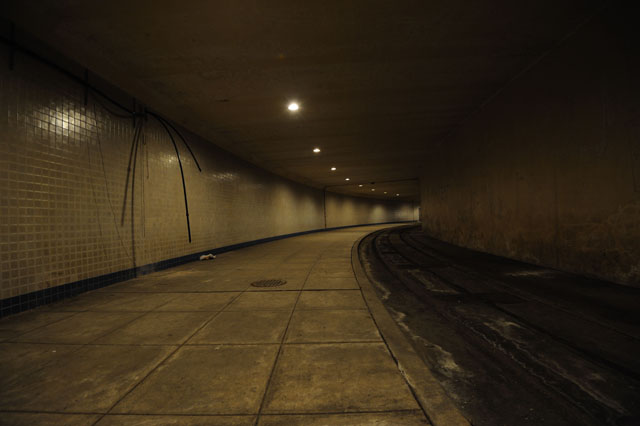 Photo by Pat Padua.
1. The Dupont underground… Most locals are familiar with the abandoned streetcar station yawning below the neighborhood’s streets, and the plans to turn it into a public arts space.
What you may not know is that the 75,000-square-foot space has served as a fallout shelter, a storage space, and a food court. The food court, in particular, did not go well.
“Apparently the ventilation failed within the first month and the place didn’t smell good … I know people who went down there during summer months and it just was not pleasant,” said Braulio Agnese, the former executive director of Dupont Underground, the organization working to revamp the space for the arts.
The food court’s chief mastermind was a bit, shall we say, subterranean himself. Entrepreneur Geary Stephen Simon had multiple fraud convictions and other things on his rap sheet when the city gave him the green light to develop.
 (Photo by Donald West)
2. …isn’t the only strange tunnel in the neighborhood.
Underneath where the Hotel Palomar now stands are 200 winding feet of thin corridors purportedly hand-dug by a local resident with a penchant for strange hobbies.
In 1924, while workers dug the foundation for a luxury apartment building, they stumbled on an underground maze of tunnels, all architecturally sound and all “broad enough for a man to walk with ease.”
There’s more. Empty alcohol bottles and old newspaper clippings on German submarine activities littered the space. Was it a speakeasy? A World War I spy hideout?
None of the above, at least if you believe Harrison Dyar.
At the turn of the century, Dyar, apparently bored by his life as an entomologist and alleged bigamist, dug the tunnels for fun.
Sorry, urban spelunkers. The tunnels were sealed with concrete decades ago.
 (Photo by Josh)
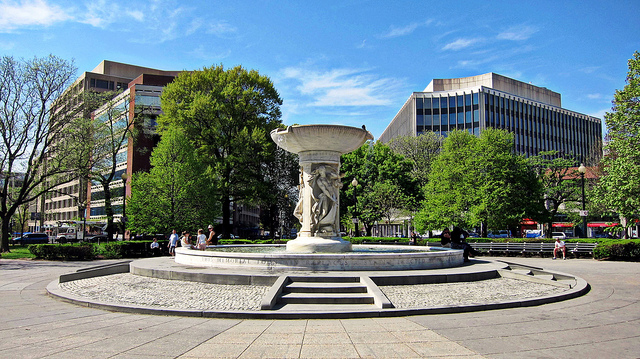
3. The same guys who designed the Dupont Circle fountain also designed the Lincoln Memorial.
The circle was originally adorned with its namesake, a statue of Civil War hero Samuel Francis Du Pont.
But people didn’t like it very much. They took to calling it “iron whiskers” and other things. Ouch, guys.
So in 1921, the rear admiral was packed up and sent north to live in Delaware, while his wealthy family helped bankroll a new fountain, complete with a fancy-schmancy electric pump.
Sparing no expense, the family commissioned sculptor Daniel Chester French and architect Henry Bacon for the job—the same men behind the Lincoln Memorial.
Another fun fact: Engineers had to raise the fountain to install the streetcar tunnels that run directly below.
 (Photo by LaTur)
4. There was once a slaughterhouse here.
This was a pretty sleepy part of the city until years after the Civil War. It’s hard to imagine big, bad Dupont Circle as a rural enclave, but that’s exactly what it was.
By and by, people began to sink roots there. A senator from Nevada, William Morris Stewart, led a group that begin to buy and develop large tracts of land in the neighborhood. The Army Corps of Engineers broke ground on actual Dupont Circle in 1871.
During those early years, though, the area held a slaughterhouse and a brick yard, among other things. Residents these days would probably pay a premium now for local artisanal pavers and charcuterie, but both are long gone.
 (Photo by Josh)
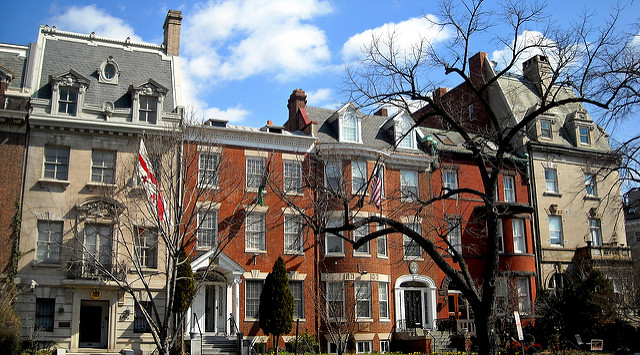
5. Embassy Row was once a neighborhood for rich people.
These grand and gorgeous structures weren’t originally designated as outposts for foreign governments. At first, Embassy Row was known as Millionaires’ Row.
During the Gilded Age of the early 1900s, wealthy people who couldn’t crack the social circles of New York or wherever else came to Washington. Big fish in a small pond and all that, what with D.C. still being a fledgling industry town at this point in time.
The relatively untrammeled physical and social grounds were a perfect playpen for nouveau riche opulence. Hey, speaking of which…
 (Courtesy of the Library of Congress Prints and Photographs Division)
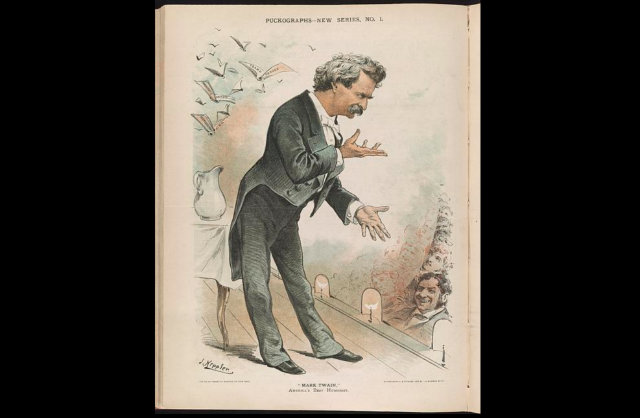
6. Mark Twain lampooned Dupont Circle’s new money in The Gilded Age.
As much as anything, those new mansion owners learned how to lobby. As they became more entrenched in the city and politics, they became a part of the ruling elite.
Twain roasted this class in his novel, taking them to task for their greed and disingenuous—or just plain ham-fisted—attempts at gentility.
 (Photo by Keith Ivey)
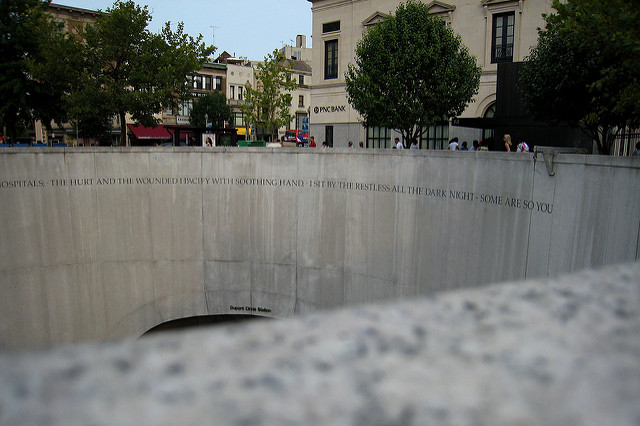
7. The Walt Whitman quote on the Metro station wall was carved there in response to the AIDS crisis:
It’s a beautiful passage, and you can see commuters and tourists regularly craning their necks to take the whole thing in. Written on the wall over the Dupont Circle Metro Station’s Q Street escalators are these words, from Walt Whitman’s poem, “The Wound-Dresser.”
“Thus in silence in dreams’ projections,
Returning, resuming, I thread my way through the hospitals;
The hurt and wounded I pacify with soothing hand,
I sit by the restless all the dark night — some are so young;
Some suffer so much — I recall the experience sweet and sad . . .”
Taken from his experiences as a medical volunteer during the Civil War, Whitman’s words took on new meaning in the 1980s and 1990s for the neighborhood, which had a large gay population (and still does, to an extent).
Years after the AIDS crisis that gripped this and many other communities, D.C. Council member Jim Graham pushed for the inscription to memorialize those who died—and those who helped. It was etched onto the station in 2007.
“That poem was inspired by his ministrations to the sick and the dying, and so that, of course, has a fitting connection to the early years of the AIDS epidemic,” Graham told The Washington Post.
 (Photo by Populuxe)
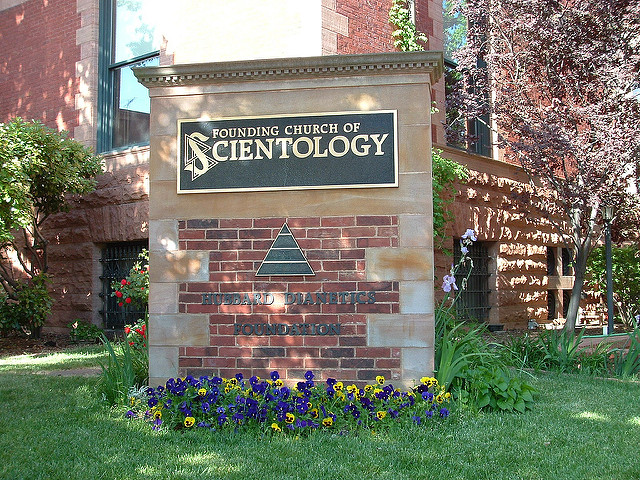
8. The very first Scientology church is here.
Long before it moved to the sprawling gardens of Florida or the glitzy hills of Hollywood, Scientology set up shop in Washington.
At 1812 19th Street NW, you can tour what is now known as the L. Ron Hubbard House, which found its way onto the National Register of Historic Places.
Hubbard himself lived here in the mid-late 1950s, during which time he incorporated it as the first official church of Scientology. Hubbard’s D.C. roots actually extend pretty far down; he attended George Washington University for a time in the 1930s, only to drop out to focus on his fledgling career as a pulp-fiction novelist.
Before the house passed to Hubbard, it served as the residence of Senator James Jones of Arkansas and Virginia Congressman Claude Swanson.
But the house’s most famous claim to fame is clearly its role as the incubator of Scientology. The first Scientology wedding happened here, as did a 1963 federal raid on the property that resulted in the seizure of more than 100 “e-meters,” which the religion’s ministers use to identify engrams and such.
Years later, Anonymous once protested outside to demand a government investigation into how the Church of Scientology got tax-exempt status.
 (Photo by Sarah Stierch)
9. Several presidents and Alexander Graham Bell lived here.
Back when Franklin and Eleanor Roosevelt were still young “pistols”—and FDR was merely the assistant secretary of the Navy—Dupont Circle was their stomping ground.
Of course, political figures aren’t going to be so uncommon given the context. Presidents Taft and Coolidge, among a host of other luminaries of the public sector, also called Dupont Circle Home.
But business leaders like the ones on Millionaires’ Row made their mark, too. Perhaps the most famous name from this side of the ledger was Alexander Graham Bell, the inventor of the telephone. Bell made a home on Connecticut Avenue, just south of the circle. As any consumer of science fiction is likely to guess, Bell outfitted his home with a number of outlandish devices, including an early stab at air conditioning.
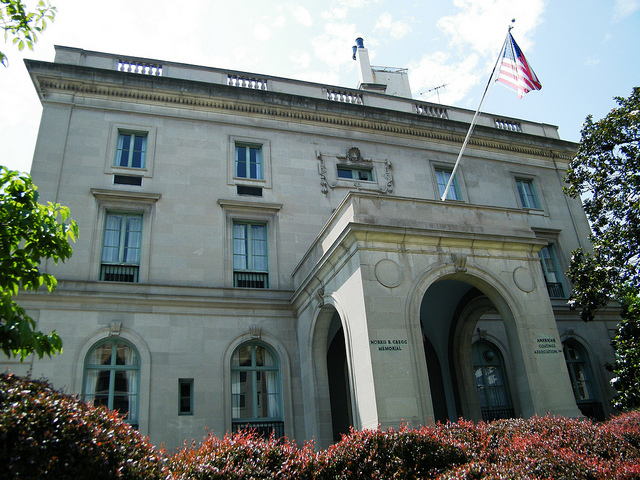
It’s not Bell’s only D.C. Dupont Circle home. Last year, the Brodhead-Bell-Morton mansion on Rhode Island Avenue, where Bell and his wife lived for a time in the late 1800s, was sold to the Hungarian government. Levi Parsons Morton bought it just days before becoming vice president under President Benjamin Harrison. It’s most recent owner, since 1939, was the American Coatings Association (previously the National Paint Varnish and Lacquer Association Inc.)
10. It’s been a home of political activism for all stripes.
In the 1970s, you might have been hard pressed to find a hotter hotbed of activism than the stretch of 20th Street between R and S Streets.
Several organizations dedicated to helping and furthering the gay community were here, as were the headquarters of the Defense Committee for the Black Panthers and the Youth International Parties, better known as the Yippees, a more militant classification of hippies.
This is far from the only place where social change took root in the area. It’s not exactly a secret (thankfully), but the Strivers Section neighborhood, where Frederick Douglass lived and became an oasis of black culture and success in the years and decades after the Civil War. The district is now on the National Register of Historic Places.
Previously:
Nine Facts You May Not Know About The Southwest Waterfront