If you’re not already familiar with avant-garde artist Yayoi Kusama’s work, over the coming months, you’ll have no choice but to get familiar. Her new survey at The Hirshhorn is already the talk of the town, and for good reason.
Kusama’s uniquely immersive installations make great esoteric selfie spaces for the casual gallery goer, but for more serious aficionados, her oeuvre is rich in themes both challenging and nourishing.
Yayoi Kusama: Infinity Mirrors is the perfect kind of exhibit for newcomers to her work. Several of her larger, interactive “kaleidoscopic environments” will be on display, arranged in something resembling chronological order.
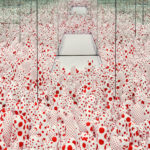
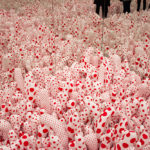
The exhibit begins with “Infinity Mirror Room—Phalli’s Field” (1966/2016) and follows all the way through to “The Obliteration Room” (2002), curated with thematic tethers between each installation to provide contextual understanding of Kusama’s evolution as an artist.
“Phalli’s Field” is a particularly striking piece, as the viewer becomes enclosed inside a mirrored room filled with red polka-dotted phalluses. At first, it feels like waking up inside a bad dream co-produced by Dr. Seuss and Sigmund Freud, a strange balance between whimsy and discomfort. However, buttressed by the surrounding work that informed the piece, like Kusama’s early sculptures covered in similarly phallic protrusions, the sensory confusion feels right at home within her journey to conquer her troubled relationship with sex from a difficult childhood. Amid controversy around Karen Pence’s advocacy for art therapy, it’s great to have such a phantasmagoric example of it in practice.
On an emotional level, the thematic evolution in Kusama’s work is stirring, but from a technical perspective, combing through her history and seeing how she adapts her ideas to various media with increasingly effective results is equally breathtaking. So much of her art concerns itself with reflexively endless motifs, from the infinity dots to the aforementioned phalluses. But seeing her early paintings and sculptures up close and noting the prolific attention to detail necessary in bringing her vision to life makes the latter work that leverages the use of mirrors and LED lights so much more impressive.
Her technical mastery mirrors her growth in using art to conquer her own personal fears. It’s a catharsis easily found for anyone willing to give up even a sliver of themselves when engaging her work.
Kusama’s work was revolutionary and a key influence on artists like Andy Warhol and Lucas Samaras, but after her time in 1970s New York, she’s rarely been given her due stateside. After this exhibit’s run here in D.C., it’ll move to other galleries in North America, from Seattle to Los Angeles and on to Toronto.
The installations require an amount of intimacy to truly behold, which means one-on-one time between the viewer and the piece. To that end, the Hirshhorn is giving out free timed passes to properly manage traffic in the exhibit, and has hired a huge number of guides and attendants to help the process along.
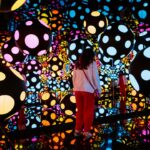
The entry point for a lot of neophytes will be the viral dissemination of fantastical social media imagery taken by those who visit the exhibit. But for anyone whose interest is first piqued by a square-framed shot of their co-worker surrounded by porous pumpkins or cartoonish penis pastiche, Infinity Mirrors is sure to be a real treat.
Infinity Mirrors begins its 14-week run tomorrow at The Hirshhorn Museum & Sculpture Garden, on Independence Ave SW. Free timed passes are distributed online on Mondays.