Rachel Kurzius
Theodore Carter does not like the city’s traffic control boxes. “They’re just ugly and unsightly,” he says. So, he’s taking action: “I decided having tentacles coming out of them would look pretty good.”
This morning, the artist and writer woke up before the crack of dawn to affix a series of tentacle-shaped drainage pipes to the top of one of the traffic boxes near his Takoma home.
But he’s not only zeroing in on traffic boxes. Mid-morning, Carter moved the tentacles to a lawn on Tenleytown main street. He’s calling it “Tentacle Tuesday.”
“I want to make some thing that is arresting and unexpected and makes people stop and wonder what they’re looking at,” he says. Folks can follow along the tentacle’s journey with the hashtag #TentacleTuesday.
You might remember Carter from his 100 Ducks project, where he enlisted the help of family and friends to make mallards out of packing tape, which he placed, lit up, on a grid in Tenleytown in February.
Why embark on such a scheme, which took more than a year? “I think meaningless things that have no monetary gain are beautiful and important,” he told us at the time. “In this city, where people are very serious, it’s important to do things that are absurd.”
Carter began his venture into street art in 2012, when he put glittery sea blobs at intersections throughout the District. It started as a way to promote his short story collection The Life Story of a Chilean Sea Blob and Other Matters of Importance, but he soon found that he enjoyed the way his creations elicited responses from passersby—a more immediate feedback loop than writing.
Hooked, he began creating more art for public spaces. He put a sculpture of his wife reading a book, rendered entirely in packing tape, in Dupont Circle.
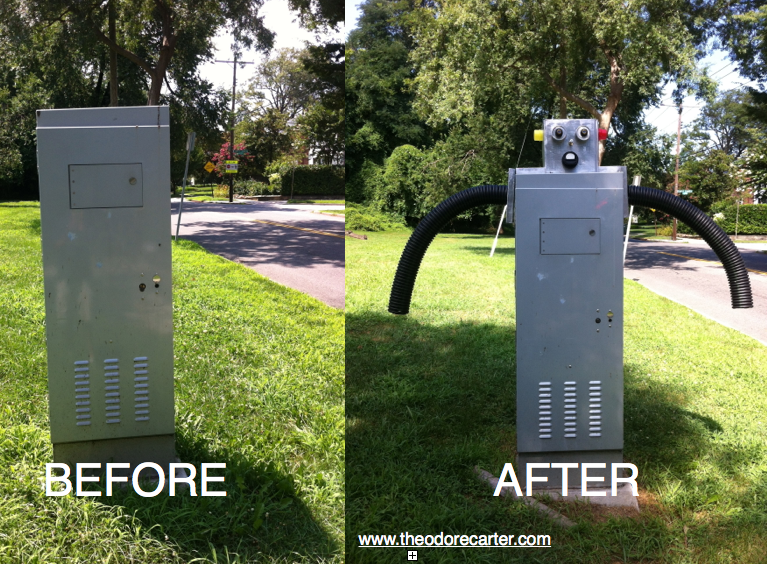
Today doesn’t mark the first time that Carter is trying to beautify traffic boxes in D.C. In the past few years, he’s turned them into a robot and the Empire State Building. He’s also tried to work through the system, sending the D.C. Commission on the Arts and Humanities a letter in 2013 suggesting the city use local arts commission funds to transform the boxes, but nothing came of the correspondence.
This time, he’s giving the traffic boxes a decidedly more nautical feel. He says that he had a couple of different ideas for converting the boxes, but when he saw a bunch of drainage pipes up for grabs in front of a neighbor’s house, the tentacle idea seemed like a good fit.
The vision of the tentacles is somewhat inspired by the Japanese artist Katsushika Hokusai, best known for his iconic print The Great Wave. Hokusai also created erotic imagery using tentacles, like The Dream of the Fisherman’s Wife, depicting an octopus pleasuring a woman.
Carter’s tentacles are more G-rated than Hokusai’s. Made of drainage pipes that can be removed from the plywood base, the piece took a couple of weeks to finish.
If all goes according to plan, he’ll pick them up this evening to place them elsewhere for another round of Tentacle Tuesday. “I’d love to put them in any area where people would be excited about them,” he says. “The problem is, I never know whether the tentacles will be up for an hour and destroyed, or be up all summer.”
But the uncertainty doesn’t bother him. “I think it’s fun—I’m not a trained artist,” Carter says. “The public reaction is greater than the art itself.”