Margaret Barthel
The Arlington County Board unanimously approved a major change Wednesday night, ending single-family only zoning in the county. The so-called “missing middle” zoning ordinance opens up residential areas currently zoned for single-family detached homes to smaller multifamily buildings of two to four units, and up to six units on certain lots.
The vote makes Arlington the first jurisdiction in the D.C. region — and one of just a handful across the country — to approve “missing middle” housing. (Other localities aren’t far behind: Montgomery County last fall passed Thrive 2050, which opens the door to future zoning changes, and neighboring Alexandria kicked off its consideration of new zoning changes this week.)
‘We have to act’
The move is a significant shift in decades of Arlington land-use policy that concentrated growth and density along transit corridors, preserving residential neighborhoods of mostly single-family homes. Fully three-quarters of Arlington’s residential neighborhoods are currently zoned for single-family only housing. Now, with housing demand and cost pressures skyrocketing, those neighborhoods could be on the hook for some additional density in the form of small multi-unit buildings — though largely kept within the design requirements and size restrictions that apply to a single-family dwelling.
“All of the growth that we have is confined to about 10% of our land area, forcing people into either medium- or high-density structures without any opportunity to participate in 90% of the rest of Arlington’s neighborhoods,” said Board Chair Christian Dorsey in comments following the vote. “I find that pretty indefensible.”
Several members of the board positioned the policy as an important step in preventing a future Arlington with housing that only serves either the very wealthy or people in subsidized affordable housing.
“A chronically supply-starved housing market in this chronically supply-starved region has long passed the threshold of causing severe economic pain to all of us,” said board member Takis Karantonis, who said he had concerns about housing issues hampering Arlington’s current streak of winning business development.
Other board members noted that Arlington is no longer affordable to people working middle-class jobs in the county, particularly young professionals seeking to buy homes.
“For our future to look like our past — where Arlington is shaped by Arlingtonians with public servants’ hearts and public servants’ salaries — we have to act,” said board member Katie Cristol.
The approval is also a symbolic rollback of decades of discriminatory exclusionary zoning policies, originally designed to keep low-income families and families of color out of certain Arlington neighborhoods. Those policies continue to have an impact on health, wealth, and educational outcomes in formerly segregated neighborhoods in Northern Virginia.
Board member Matt de Ferranti pointed to that legacy, calling single-family zoning “the continuation of regulatory action by our county government that has protected the wealth of those already living in single family neighborhoods and prevented those who do not live in those neighborhoods from building wealth of their own.”
Some limitations for small lots
While the final vote was unanimous, with all five board members supporting some version of the policy, along the way there was disagreement, and ultimately members compromised on some of the details. Many supporters believe those details could have an impact on whether the policy succeeds in providing new housing options for residents looking for a dwelling somewhere between a high-rise apartment building and a single-family detached home.
In the end, the board hammered out a compromise preserving some of what supporters said were the “most expansive” aspects of the policy, but added some building restrictions for smaller residential lots. All “missing middle” projects will be required to adhere to setbacks, lot coverage constraints, and other design standards currently required of single-family construction.
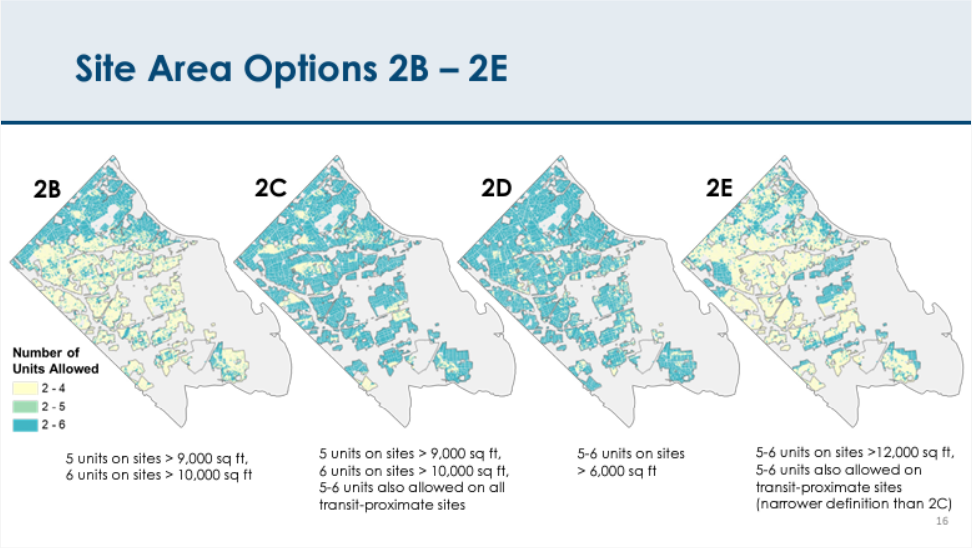
One of the key areas of compromise was “minimum site area,” a zoning term meaning the number of units allowed on a site of a particular size. The most unrestricted option would have allowed up to six units on all residential lots in the county, effectively relying on other restrictions in the zoning code to prevent overly large buildings on smaller lots. But after robust debate, the board chose an option that will allow 5- and 6-unit buildings only on lots above 6,000 square feet (and in some special cases, above 7,000 square feet).
Parking requirements were also the subject of debate among community members and board members. The board approved a version of the plan requiring developers to build 0.5 parking spaces per unit on lots designated as “transit proximate,” meaning that they are three-quarters of a mile or less away from a Metro station or a half mile away or less from transitways like the Columbia Pike or Crystal City corridors. Buildings further from transit or on cul-de-sacs would still need to include one space per unit, though parking requirements are also subject to review if the county determines that on-street parking in the neighborhood in question is underutilized.
Another major area of debate was a proposed annual cap on permits for new construction, which the board set at 58 units per year — a number well over what county estimates suggest might actually be built — until 2028.
‘I’m over the moon’
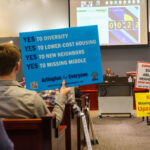
The board room was full of supporters and opponents on Wednesday, all there to mark the historic moment after a hard-fought, often contentious public debate. The crowd was mostly quiet during the board debate, but the room erupted in cheers and clapping from supporters after Dorsey declared the meeting adjourned. Opponents held up tombstone-shaped signs with the words “RIP the Arlington Way,” written on them in marker.
“For the first time in almost a century, the County Board took direct action to reverse exclusionary zoning in our county,” said Mike Hemminger, who leads the Arlington chapter of the NAACP, in an interview immediately after the vote. “I’m over the moon. I’m ecstatic.”
While the zoning ordinance change takes effect this summer, how and when the new impacts of the change will play out in the local housing market and in Arlington residential neighborhoods is not entirely clear. The zoning change is a market-based reform; it allows developers or current homeowners to create multi-unit buildings on lots as they become available.
Some opponents of the plan have long maintained that it will drastically inflate already-high land values in Arlington, causing massive sell-offs of existing single-family homes and rapidly converting entire single-family neighborhoods into blocks of multi-family, mostly rental buildings.
“This doesn’t leave any protection for single-family [homes] whatsoever,” said Anne Bodine, a leader with Arlingtonians For Our Sustainable Future, a group opposed to the plan.
Looking ahead, Bodine said she wants to see the county do analysis on how the policy is impacting the county’s diversity.
Kathy Rehill, a local realtor who was also opposed to the plan, said she worries about the new zoning changes accelerating teardowns of older homes in the county.
“I think it’s really important that they did a cap,” she told WAMU/DCist. “Going forward they need to collect data about what houses were lost. Did we see the teardowns change?”
County estimates tell a different story, suggesting that the number of permits issued for construction for the new buildings might come in at around 20 per year, at least initially. That jives with how similar zoning changes have played out in the handful of areas that have already implemented them, including Minneapolis and Portland, Oregon. Some recent research indicates that localities may need to pair zoning reform with other land-use tools and design flexibility to get developers to switch to building multi-unit buildings instead of large, expensive single-family homes.
Tracking the impact
Board members have pledged that the county will collect data and evaluate the impacts of the policy as it moves forward. In an interview following the vote, Karantonis said he’d be looking for “red flags” of the policy not working as intended — including if only one “missing middle” building type was being built, or if construction was somehow skewed to one particular neighborhood. He also said the county should evaluate the new housing in conjunction with new demographic makeup of new residents moving to the county.
“It’s very important to see the context of things and have an honest conversation with our community and report on this,” he said.
In some ways, Karantonis said, that process would be new. “For basically the entirety of our lives, we never actually reported in an orderly way about how 75% of our land use was performing,” he said, referring to the portion of residential areas currently zoned single-family only
‘Change is inevitable’
The vote in Arlington comes after a years-long, frequently contentious public engagement process that highlighted fault lines in the county between older, whiter homeowners and its younger, more diverse population of renters, who now make up the majority of residents.
The most recent example of that fracture was on full display during the public comment period at the board’s Saturday and Tuesday meetings, where more than 220 people took to the mic to argue one side or the other. Some did so in creative ways, including several missing middle poetry readings, a rap about housing economics (“Nice lyrics, but gotta work on your flow,” Dorsey commented drily), and an image of Godzilla appearing to devour a single-family home.
Proponents of the zoning change to expand housing options argue that doing so will create a more diverse supply of homes, offering options in-between large single-family homes and high-rise, mostly rental apartment buildings that could serve a growing and more diverse population. They say adding density in walkable Arlington will help cut down on transportation-related greenhouse gas emissions. And while initial construction will still be expensive, they see the policy as a way to eventually increase the county’s supply of starter homes, helping to reverse the trend of young professionals leaving the county when they start families or decide to buy real estate.
“Change is inevitable,” said Marjorie Green, a longtime Arlington homeowner and advocate with Virginians Organizing For Interfaith Community Engagement, a group that has supported the policy. “How we shape change directly reflects our values as a community. A healthy community prioritizes the needs of its current residents and opportunities for future generations.”
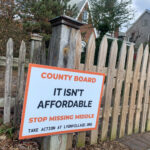
Opponents, meanwhile, see the plan as a harbinger of gentrification and displacement, particularly for residents on low- and middle-incomes and seniors on fixed incomes, groups already struggling as property taxes and rent increase track the rise in value of land in Arlington. They believe the move represents a blank check to developers, and a major strain on county services and infrastructure. Some have spoken darkly in terms of rapid urbanization, and several opponents said in public comment that they would sell their single-family homes and move if multifamily development comes to their street.
“What is on the table will exacerbate inequities between different areas of the county and bring extreme differences in density,” said opponent Dima Hakura. “It will lead to haphazard densification and it will be a boon to developers and investors.”
Some opponents have also been highly critical of the county’s engagement process related to the policy, suggesting it has ignored their concerns and struck at the heart of “the Arlington Way” — the idea that the county’s public discourse must strive for consensus. The Arlington Civic Federation, an overarching body of neighborhood associations and other civic groups, passed a controversial resolution giving voice to those frustrations.
The resolution accused the county of pursuing a predetermined outcome, and along the way stifling public feedback and ignoring issues raised by residents and in studies about the policy change.
But the Civic Federation’s resolution, it turned out, struggled to create consensus too: the local branch of the NAACP, which has been a vocal supporter of the most expansive versions of the plan, withdrew from the body in protest.
A ‘litmus test’ in upcoming elections
While the board vote may be over, the anger and division it exposed appear likely to live on in county politics. The split could become a factor in the county’s upcoming planning process to set the vision for a denser Langston Boulevard corridor — and in this year’s round of elections.
Arlington voters will head to the polls in June to select candidates for two county board seats, which Dorsey and Cristol — the body’s most outspoken expanded housing option champions — are vacating next year.
Six candidates have already announced their candidacies in the Democratic primary, which is likely to determine the final outcome in November, given Arlington’s deep-blue tilt. Several contenders in that primary have already taken positions on the proposed zoning change, and three of them spoke to the Board on Saturday during public comment. Susan Cunningham and Natalie Roy criticized the public engagement process and urged the county to reconsider or delay its approval of the policy, while Julius D. “JD” Spain spoke in strong support.
Meanwhile, several civic leaders said on Twitter that candidates’ position on the housing policy should be a litmus test for Democratic voters.
“As Deputy Chair of the Arlington County Democrats, I’m breaking my silence to say that I can not and will not support ANY candidate seeking to keep exclusionary zoning practices in Arlington,” wrote Hemminger. “We are the party of housing for all. Anything less is not acceptable.”
In public comment, both sides of the debate sought to reassure the board that their side was the winning one politically.
“I voted for each and every one of you,” Tierney Farrell, an opponent, told the board on Tuesday evening. “That’s a mistake I won’t make again.”
“Sometimes, as a board member, you’re faced with a tough decision between good policy and good politics,” said Grace White, representing YIMBYs of NoVA. “Luckily, in this case you don’t have to choose. Missing middle is popular. Outside of civic association meetings and disproportionately white and wealthy meetings, most of your residents support this.”
On Wednesday, Dorsey thanked community members for “good faith” public engagement, and attempted to unify the sharply divided sides.
“The one thing that has become clear is that despite our positional viewpoints on this issue, people really like Arlington, and that’s something that should galvanize us and bring us together,” he said.