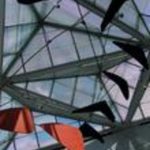

After more than a year’s absence, Alexander Calder’s massive mobile “Untitled” (1976) returns to the atrium of the National Gallery of Art’s East Building. The sculpture was disassembled on April 19, 2004, in order to undergo conservation treatment to enable greater freedom of movement. As the Post reported yesterday:
With a new paint job and “hardfacing” work (a surface treatment that will allow the pieces to move more freely on their connecting loops), the mobile should behave more like a mobile these days.
The sculpture was reinstalled on June 7 by National Gallery staff and engineers, including artist-engineer Paul Matisse (grandson of Henri Matisse). The mobile weighs 920 pounds and consists of thirteen panels and thirteen arms constructed of aluminum honeycomb and aluminum and steel bars. According to the National Gallery, the piece was originally supposed to be made from steel; however, the medium proved too heavy and was instead commissioned the alternative metal. First installed Nov. 18, 1977, the last time the mobile received conservation treatment was 1988.
“Untitled” 1976 moves freely with only slight assistance from wind currents in the atrium. As it gently dances around, it mesmerizes locals and tourists alike. This DCist has seen more than a few people crash into each other walking across the floor while looking up at it.
(Image of “Black, White, and Ten Red” (1957) at the National Gallery)