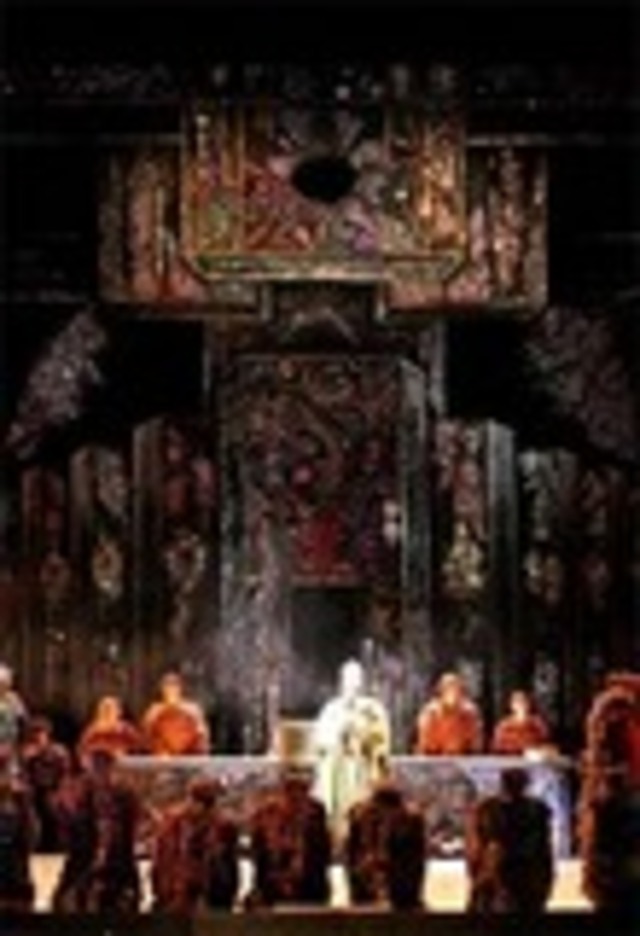
 You probably know by now, because we won’t shut up about it, that the Kirov Opera is visiting the Kennedy Center this week. We have already recommended their production of Puccini’s Turandot. Last night, we were in the Opera House again, to see the Kirov perform Wagner’s Parsifal, which the composer insisted was not an opera but a “stage-consecrating festival drama.” (This reminds me that what you are reading is not a post, but a “computer-cleansing ritual article.”) A full staging of this opera requires the dedication of five good hours of listening, so the curtain was scheduled for the unusually early time of 6 p.m. and we were not on the way home until a few minutes after 11. This may have kept the event from selling out, but there are apparently enough Wagner nuts in Washington for a respectable crowd not only to show up but also to stay until the bitter (glorious) end.
Once again, star conductor Valery Gergiev gave an inspired reading of a richly orchestrated score — like Turandot for Puccini, the last that Wagner composed — in which a complicated system of Leitmotifs (melodic themes that are associated with characters or ideas in the opera) is woven into complex and often dissonant harmonic structures. In Gergiev’s orchestra, the woodwinds had a few sloppy moments, the worst being the 672nd time (approximately) that they played the little melodic snippet associated with the Holy Grail in the first act. The brass were generally quite good, especially the lengthy sonic boom that Wagner wrote for them in the middle of the third act and the burnished trumpet scintillating behind the Grundthema, the main theme of Parsifal that opens the opera. The worst sound of the evening came from what are supposed to be bells, which play a crucial role in the scenes in the Hall of the Grail, played last night on what sounded like a $50 synthesizer that belonged in a bad children’s music recording rather than in a major opera company’s production. What should add to the impression of an incense-filled sanctuary — for what is more or less Wagner’s operatic setting of the words of the Catholic Mass — instead induced embarrassed laughter.