This post was written by DCist contributor Heather Goss.
How can an artist capture the passage of time in a still photograph? That’s one of the questions acclaimed Japanese photographer Hiroshi Sugimoto has been pursuing throughout his thirty-year career.
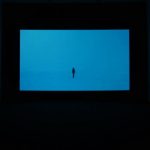
 Sugimoto, whose retrospective exhibition at the Hirshhorn Museum and Sculpture Garden opened last week, uses a minimalist technique in his photographs to highlight the perspective from which they are taken. His well-known “Theaters” series is a prime example. By opening the shutter of his large-format camera for the duration of a movie, he creates an image of a glowing, white screen. The resulting photograph is a single shot that has captured an entire story and all its accompanying emotions. The simple white rectangle is the summation of this passage of time.
During his artist’s lecture last Thursday, Sugimoto discussed in his witty and charmingly egotistical manner how he uses photography to incorporate these questions of time and reality. The artist also gave the audience an insider peek at his workbooks, each one filled with mathematical equations and detailed drawings. Far from a point-and-shoot ’em kind of guy, he fully conceptualizes each photograph before a single photon of light hits film. Interestingly, it turns out that this “conceptualizing” may be fairly well aided by the occasional acid trip. All this leaves the viewer with a simple, but richly detailed image that evokes mind-bending questions about reality and how we view it.