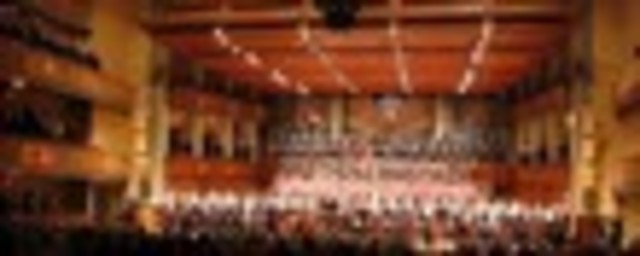
When Gustav Mahler, near the end of his life, conducted the world premiere of his eighth symphony, in Munich in 1910, he did so with amassed musical forces — orchestra, eight vocal soloists, off-stage brass, and several large choruses of adults and children — numbering over 1,000 people. Although Mahler never liked the name, the work is still often known as the “Symphony of a Thousand.” More an oratorio than a symphony in many ways, it ends with a mysterious exaltation of the Sacred Feminine (literally, Das Ewig-Weibliche), in the musical climax called the Chorus Mysticus. No, it has nothing to do with The Da Vinci Code. Although the end of Goethe’s Faust would be a logical choice for a quick name-dropping reference in Dan Brown’s hack novel, given how the man writes, it seems unlikely that he has read Faust.

Last night in the Kennedy Center, the National Symphony Orchestra and friends (Cathedral Choral Society, Children’s Chorus of Washington, Choral Arts Society of Washington, Master Chorale of Washington, and the Washington Chorus) reached only about half that number, but it was still impressive to hear that many musicians confront Mahler’s sometimes bombastic score. The Concert Hall is not large enough to accommodate that many people on the stage, so some of the singers and the added brass players (who sounded impressively like the apocalyptic last trumpet, as they should) stood in the second tier of seats, reaching toward the back of the hall.