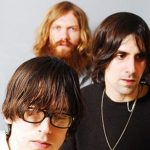

The members of Dead Meadow were born in the wrong decade. While the D.C. scene of the ‘80s and ‘90s revolved around harDCore punk, typified by bands like Fugazi and Rites of Spring, the future members of Dead Meadow found themselves drawn to the Zeppelin-style hard rock of the late ‘60s and early ‘70s. Jason Simon, Mark Laughlin, and Steve Kille played separately in bands on the periphery of the D.C. music scene, including Colour and Impossible Five, before forming Dead Meadow together in 1998. The guys channeled their pent-up estrangement into a common vision: eardrum-bursting rock combined with incense-and-peppermints psychedelia.
A lot has changed for Dead Meadow in the past 8 years. Drummer Mark Laughlin left the band in 2002, and was replaced by Steve McCarty shortly before the band signed with Matador Records. They released five albums in five years, including a live compilation produced by Anton Newcombe of the Brian Jonestown Massacre. These five albums represent an accelerated lifetime of musical experimentation, during which DM dabbled in neo-psychedelia, blues, punk, and full-blown metal. This makes them impossible to classify, and, paradoxically, as DM gain more and more recognition, they find themselves feeling the same alienation that they have dealt with from the beginning. But the guys have embraced their outsider status as a key ingredient to their sound and their staying power. Bassist Steve Kille says, “Once you’re in a genre, you become dispensible. You’re only gonna last for the moment. It’s tough for the average band to do something without a cliché association. If you do your own thing, you’ll be much better off. Like Nirvana. Nobody in that band sat around and thought, ‘How do we make this sound more grunge?’”
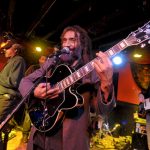
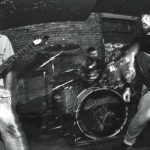
A Dead Meadow concert feels like a time-warp back to an era of bead curtains and drug overdoses. When they headlined at the Rock and Roll Hotel, earlier this month, their openers were indie-folk acts Laura Burhenn and Meredith Bragg and the Terminals, but had they been around during rock’s Golden Age, DM would have been an apt opening act for Pink Floyd or the Doors. Their songs are long and bleed into eachother, with recurring guitar riffs cropping up throughout. This means that their live performances aren’t driven by a setlist, per se, but by a scopic experience that is by turns deafening and mesmerizing.