 “It will be for a more skilled hand than mine to rear the superstructure.” William Henry Fox Talbot made this statement in the mid-1800s, after he had developed his patented Calotype process, a technique that helped establish modern photography. His inability to draw made him search for a way to make direct impressions of the world around him, and while there’s something to be said for artistic impressions that allow us to see things in a different way, Talbot noted that his precise copies perhaps give the viewer more insight, since they reveal minute details that might otherwise have gone unnoticed.
It is with this virtue in mind that the skilled hand of Molly Springfield developed her pieces for Gentle Reader, showing now at Transformer. Part of the exhibit is devoted to detailed copies of texts by and about Talbot, while the other is a small collection of her own calotypes, images made from Talbot’s writing. The result is a somewhat circular but highly intriguing exploration into the nature and purpose of reproduction.
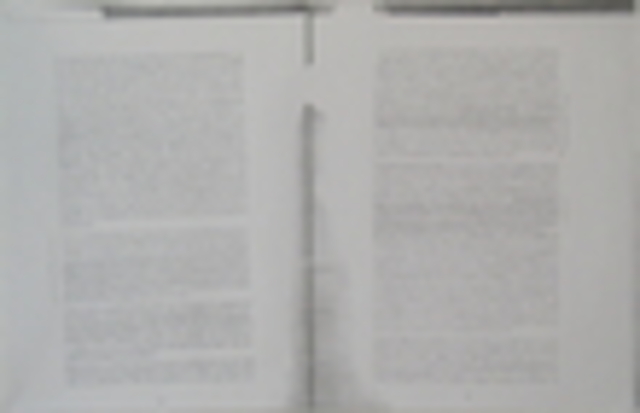
Springfield provides particularly useful insight with A Dual Nature (pictured), her exact drawing of a (xeroxed) copy of a text that explains the purpose of copied images. Got that? In it, the text reads that Talbot believed “[t]he scientific view of life was connected to the artistic” and that “a sharp distinction between documentary and pictorial schools of photography … creates an artificial polarity, for in fact the function and style of most photographs is intertwined.” Here Springfield has created a piece of art in reverse — she doesn’t ask the viewer to see the subject (the text) through her artistic eyes, instead, it’s the subject that asks us to observe and ask questions of its creator.