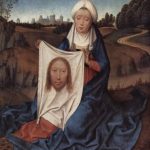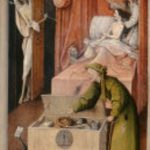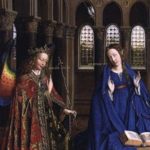
Art collecting and patronage, an art in its own right, is often a very personal enterprise that can reveal a good deal about the collector. Fifteenth and sixteenth century Netherlandish diptych collectors — the subjects of an innovative exhibit at the National Gallery called Prayers and Portraits: Unfolding the Netherlandish Diptych — literally collected in their own image.

A diptych is two panels that are attached with hinges, so they can open and close like a book. One panel typically depicts saints, while the other shows the patron or patrons. The panels are often framed individually and hung on the wall, or opened part way and placed on a table to be used by worshippers for private meditation.
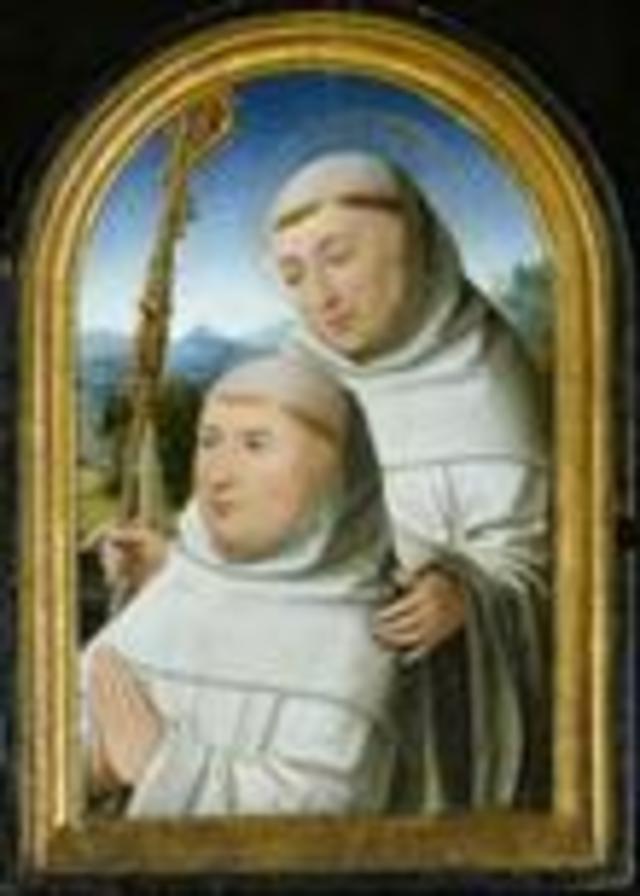
In the oil painting on the right (c. 1507/1533), which is half of a diptych, Jean Bellegambe shows Saint Bernard alongside a Cistercian Monk. The saint is easily recognized by his halo, but a comparative analysis of the two figures yields far more similarities than differences. Even if the saint is taller in stature and carries an ornate walking stick, the very notion that the monk has been visited by the saint (who puts an encouraging hand on the monk’s shoulder), flatters him. The painting was commissioned by Jeanne de Boubais, the abbess of the Cistercian convent, who appears in the other half of the diptych. There seems to be a certain arrogance in commissioning the sort of work that places one’s self (and one’s fellow monks) on the same level as a saint.