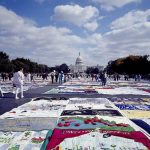
More than two decades after the first cases of a strange “immunity systems ailment” appeared in Washington, today’s observance of World AIDS Day sees the epidemic still rampant, both in the city and around the world. While the number of new infections peaked in the District in 1993 at 1342 cases, it remains persistent. Despite massive education and “get tested” initiatives, the number of new infections in D.C. still hovers around 900 per year. We’ve all seen the haunting statistics in the papers and on ads throughout the city:
One in twenty people in the District are living with HIV/AIDS.
If D.C. were a country, it would rank 11th in the world in AIDS infections.
In the Washington region, there are nearly 30,000 people living with HIV/AIDS.
To mark the 25th anniversary of the AIDS epidemic, the Washington Post has set up an exceptional Web site focusing on the disease’s impact on D.C. Included is the newspaper archives, where you can read the paper’s early attempts to describe this strange new disease in 1981:
Overall, more than 40 percent of the cases reported to the CDC and two-thirds of the 19 patients described in the New England Journal have died of what appears to be an entirely new syndrome involving more than a dozen types of organisms.
More than 80 percent of the cases come from New York City, Los Angeles and San Francisco, but one death in a young District of Columbia homosexual was reported. The cases continue to be reported at the rate of five or six each week.
There are few health issues as critical to the District as reining in the effect of AIDS, and we, too, have often written about the epidemic.
The Whitman-Walker Clinic, which has served on the front lines of the fight against HIV since the very beginning, has a listing of local events going on to mark World AIDS Day, including the Candlelight Vigil tonight at Freedom Plaza on 14th Street downtown.
For a great deal of more information on local efforts to fight the disease, see AIDSinDC.org.