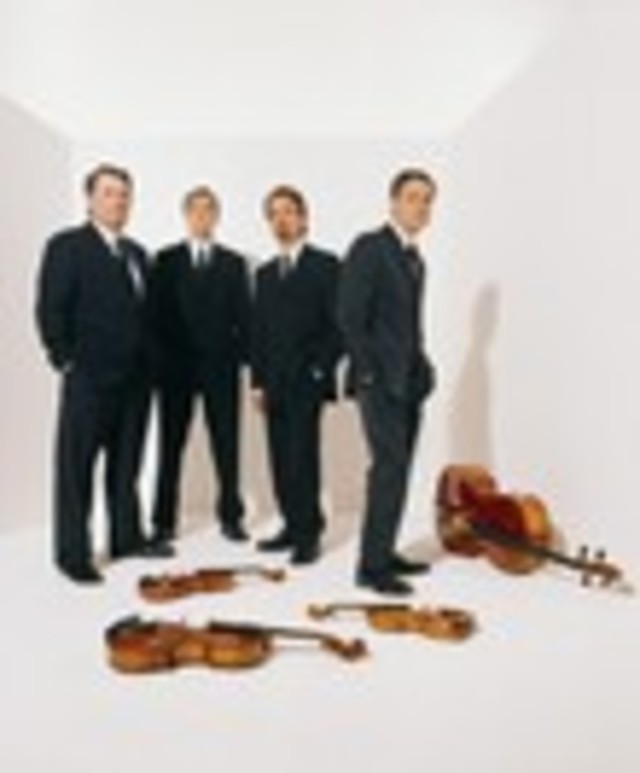
 Last year’s celebration of the 100th birthday of Dmitri Shostakovich, on September 25, fizzled out somewhat here in Washington. This week, dedicated listeners had the chance to take their fill of the Russian composer’s music. After a thundering concert performance of Lady Macbeth of Mtsensk by the Kirov Opera on Sunday, it was the Emerson Quartet who brought the early half of their complete cycle of Shostakovich’s fifteen string quartets, played to great acclaim in London and other places (available in a live recording made at the Aspen Music Festival several years ago). On Monday, Tuesday, and Wednesday evening in the sold-out Kennedy Center Terrace Theater, the most attentive audience in recent Washington history heard the first eight string quartets and the piano quintet. With coughing and other distracting noise kept to a striking minimum, one had the feeling of being in the company of serious listeners. A man in front of me cupped his hand to his ear to focus on the quartet’s sound if there was too much rustling of programs near him.
The Emerson’s violist, Lawrence Dutton, had a shoulder surgery in July, requiring this Shostakovich cycle to be delayed from its originally scheduled time last October, as well as some creative reconfiguring of other scheduled concerts. Back in the saddle, Dutton seemed in good form, at one point stretching his fingers mid-movement, as if he had some minor discomfort, but nothing serious. Dutton’s solo at the opening of the second movement of the “Springtime” quartet (no. 1, op. 49), the first offering on Monday night, was an effectively melancholy lament. That quartet is a lovely wisp of a thing, much of it played quietly. The Emersons’ performance was a little rough and self-suffocated, but the group went on to give superb readings of the meatier no. 7 (op. 108), with its eerie duets in the first two movements and the raucous, harried third movement. That first concert concluded with no. 5 (op. 92), which opened with a driven, folksy rendition of the moto perpetuo first movement. Cellist David Finckel played the gorgeous cello solo in the Andante with consummate lyricism.
Sometimes the rustic side of Shostakovich’s folk-inspired writing turns a little too much toward Turkey in the Straw, to draw an American parallel, as in the buoyant first movement of no. 2 (op. 68), which opened the Tuesday concert. The best performances that evening came on no. 4 (op. 83), an overtly emotional work, bordering on but never reaching the saccharine quality of Rachmaninov. On Tuesday evening, Eugene Drucker sat as first violin — or rather stood, since the Emersons, except for cellist Finckel, play standing — and he gave an exceptional reading of the main theme of this quartet’s slow movement. The evening closed with no. 8 (op. 110), a favorite of this reviewer (heard from the Jerusalem Quartet last April), which is a weighty, autobiographical work infused with the musical theme Shostakovich created for himself from the letters DSCH, which work out in solfège to D, E-flat, C, B-natural. As a personal response to the suffering of the city of Dresden during World War II, no. 8 is a terrifying work of edgy rawness, and the Emersons captured that quality superbly, not least in the brutal sound of gunshots evoked in the fourth movement.
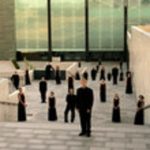
Photo of the Emerson Quartet by Mitch Jenkins