 One could do worse things with one’s retirement than playing the Mozart quintets with every string quartet possible. Since violist Roger Tapping retired from the Takács Quartet, he has appeared in Washington as the fifth wheel with the Jupiter Quartet, the Parker Quartet, and the Daedalus Quartet. This month, Tapping is at it again, with the Auryn Quartet from Cologne, in a series of three consecutive Sunday concerts sponsored by the Foundation for Advanced Education in the Sciences at Bethesda’s Congregation Beth El. Throw in all three of Britten’s quartets with all six of the Mozart quintets, and you’ve sold me.
The first concert last Sunday opened with the earliest quintet (B-flat major, K. 174), composed in 1773 while Mozart was still in Salzburg. What seemed like a rough start — intonation disagreements, the pacing not quite unified — to this performance was smoothed over by the time the Auryn Quartet + Tapping repeated the exposition. The second movement, con sordini, was simple and understated in style, with lovely dialogue between the first violin and viola. When Mozart revised this quintet, he gave the Menuetto a trio section dominated by a charming echo effect. The sonic differentiation of statements and echos was superb in this performance, followed by a last movement pushed to the fast side of Allegro, combining technical assurance with clear understanding of form.
After intermission, it was what would likely be my favorite Mozart quintet, if forced to answer the question, the G minor, K. 516. I would have expected this sublime work to have been reserved for the final concert, probably paired with its sunnier twin from the same period, K. 515 (both completed in 1787), which is indeed scheduled for the third Sunday. Yet here it was, in the key shared by some of Mozart’s most expressive works. The best parts of the first movement are in the development, especially when at one point all of the instruments play the theme in a closely overlapping stretto, and in the dark-hued coda. At these contrapuntal moments, the players’ eyes lit up as they translated the form into sound. The Menuetto and its briefly clarified major-key trio, shifted to the second movement, had a well-paced dance-like character. By the time the somber third movement and the suddenly hopeful G major conclusion struck our ears, the group had long ago hit its stride.
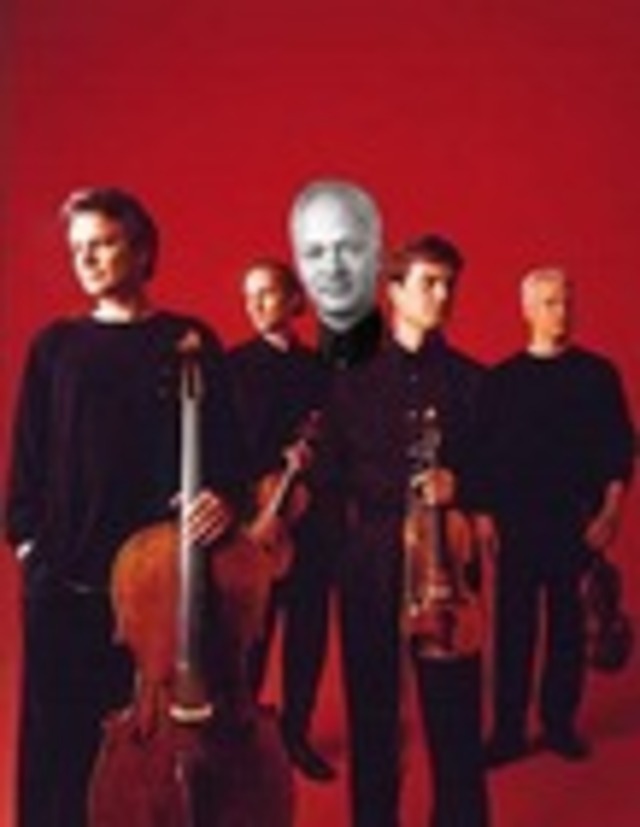
Auryn Quartett with Roger Tapping, with apologies to Manfred Esser (photo credit)