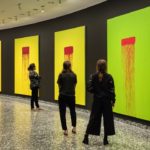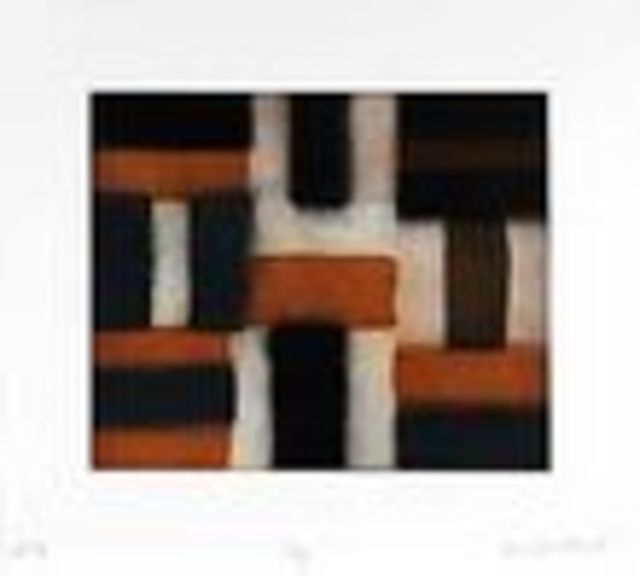

The Prints of Sean Scully, on view at the Smithsonian American Art Museum, is a thoughtful mini-retrospective chosen from a master set of prints that the artist gave to the permanent collection. Of the artist’s defiant set of prints, these are an answer to the ubiquitously decided notion that abstraction is super passé. His use of multiple printmaking methods on each print gives the works their tension. You name it, he’s done it: aquatint, monoprint, lithography, spitbite, sugarlift, etc. He departs from the typical refined surfaces produced by droves of other printmakers, and expands the complexity of his surfaces by mixing difficult printing techniques into strong technical cocktails.
Every piece of paper shares an unapologetic boldness that propagates his color blocks with unmistakable frenzy. Even when the plate has been left bare, the leftover, imprecise scratches become a forest of Scully’s signature crazed style. His prints are physical. So much that you imagine him relentlessly chiseling away at a woodcut, rhythmically inking up his plates, and stopping only to inspect that wobbly line that he teeters on somewhere between unrefined and delicate.
Walking through the exhibition, one might get exhausted by the outwardly repetitive forms – the horizontals and verticals, the kitchen-floor checkerboards, the inky black spots and smudges. The forms can actually become very boring to see over and over again. But the very act of making prints is repetitious – in fact, Scully got his first taste of printmaking in a commercial workshop pressing race ballots – and much like his abstract paintings, his prints chant the same intriguing lyrics.