 The most recent exhibition at the Smithsonian’s Arthur M. Sackler Gallery, organized with help from the National Museum of African Art, Encompassing the Globe: Portugal and the World in the 16th and 17th Centuries, is as much a chronicle of history as it is a document for how art records history. Trying to pigeonhole this exhibition into a one category is difficult. It is more than just the fact the exhibition displays more than 260 objects, from several nations, which were created over the span of two centuries. Partly, it is that a gallery typically focused on the art of Asia is featuring a show about Portugal. Partly it is a remark made by Portugal’s Minister of Economy and Innovation positioning Portugal as the leader of the first age of globalization. The explanations layer like an onion.
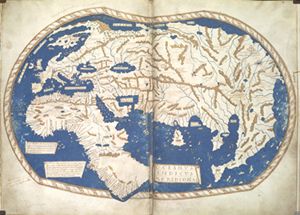
Bordered as much by sea as by Spain, Portugal possessed an ability to construct fast naval vessels for the purposes of exploration, and they would use this to their advantage. The world in 1475 was rather limited. Though mathematicians and astronomers alike assumed the earth was round, no one had yet proved it. North and South America were undiscovered masses of land, as were Australia and Antarctica. No one in Europe had sailed in an ocean defined as the Pacific, and no explorer had found a navigable route around that expansive continent to the south, Africa. The Portuguese explorer, Bartolomeu Dias, was the first to get around the Cape of Good Hope by 1488. This was used to the advantage of the Portuguese in the spice trade, building forts and treaties in places like Mozambique, Oman, Persia, India, Sri Lanka, Moluccas (The Spice Islands), China and Japan. By 1500 the Portuguese had also sailed to the new world and established a colony in what has since become Brazil.
Portugal becomes the interesting protagonist of this exhibition because as it was mapping the globe it left considerable influence on the nations and cultures it encountered. And that influence has its roots in the spice trade. It is easy to forget in 2007 that the trade of spices would provide economic advantage or be the stuff over which battles were fought, but keep in mind the that few spices grew naturally in Europe in the 16th and 17th centuries, except perhaps black pepper, with salt a close second and reserved for the more affluent. As for cinnamon, mace, nutmeg, ginger or clove, according to James Turner’s essay in the exhibition’s accompanying text, it had to be imported from the east, and most of those imports came via land through Middle Eastern merchants.