 >> The Classical Music Agenda will return this Sunday, after hibernating all summer, but there are already a few developments to note this week in local classical news. Robert Shafer is a legend in the local choral music scene, as the long-standing director of the Oratorio Society of Washington, known in recent years as the Washington Chorus. Shafer’s particular gift is to inspire a huge group — some 200 singers, none (or few) of them professionals — and draw from them as memorable and unified a performance as he can. After leading the group in a Grammy award-winning recording of Benjamin Britten’s War Requiem, Shafer was as surprised as anyone when, after asking for a sabbatical, he was pushed out of his position. The group will be led this season by three different guest conductors.
Not ready to retire, Shafer has embarked on a new venture, muddying the already overpopulated choral waters of Washington with yet another volunteer chorus, the City Choir of Washington. The move to a smaller group, described as 90 voices, has apparently been liberating in terms of Shafer’s choice of repertory for his first season. It is all Baroque and none of it the chestnuts that are the bread and butter of his former group: Handel’s Solomon (November 16) and Monteverdi’s 1610 Vespers, especially. We can all be thankful that there will not be yet another Messiah this December, at least not this season.
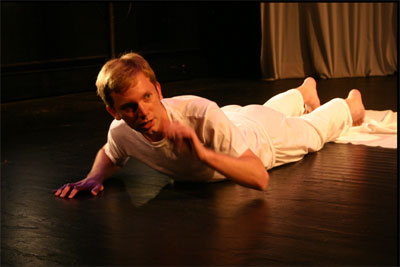
>> In the immediate future, the following concerts this weekend are of particular interest. The first recommendation of the season goes to the revival of American Opera Theater‘s Ground (September 7 to 9), which will inaugurate the company’s residency at Davis Performing Arts Center, on the campus of Georgetown University. When the experimental opera troupe from Baltimore (formerly known as Ignoti Dei Opera), presented Ground at Baltimore Theater Project last summer, it received a stellar review from a certain local critic. For its musical score, Ground patches together a series of unrelated vocal and instrumental pieces from 17th century Italy. Most of the music is built over repeating bass patterns (known in English as ground bass), a compositional process that is static harmonically but that pulsates with rhythmic variation and invites visual diversion.
Photo of Brian Cummings in Ground by Greg McLeskey, courtesy of American Opera Theater