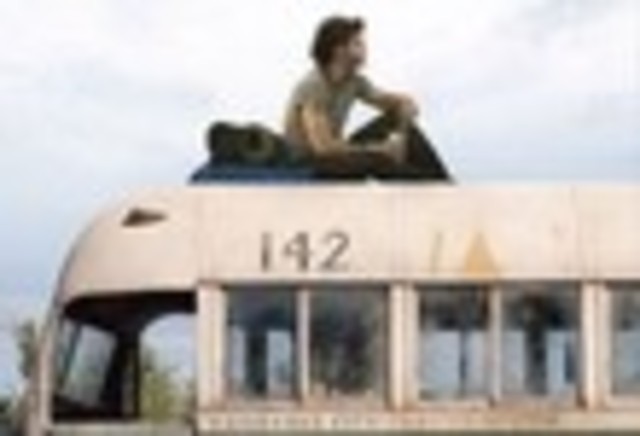
 Early in Sean Penn’s new film, Into the Wild, a pickup truck driving across a frozen landscape drops a young man off at the literal end of the road. The young man is Emile Hirsch, who portrays Christopher McCandless, the Annandale native who sent his $25,000 life savings to Oxfam and disappeared abruptly after graduating from college in 1990. The man driving the truck is James Gallien, who also happens to be the same man who dropped the real McCandless off near Denali National Park in the Alaskan wilderness 15 years ago. It’s a fitting opening for a film that attempts to inject the reconstruction of McCandless’ journeys with as much truth as possible. Penn uses non-actors throughout the film, lending the film an air that is realistic without seeming documentarian.
After Jon Krakauer published his popular book reconstructing the travels of McCandless in 1996, opinions on the young man tended to fall into one of two camps. For some, he was a folk hero of sorts, a wide-eyed idealist bravely shunning the constraints of a culture obsessed with controlling the populace through materialism and arbitrary rulemaking. For others, he was a crackpot hippie, a drifter who likely was mentally ill, and whose lack of respect for the nature he desired to commune with led inevitably to his death. The truth, as is usually the case, probably lies somewhere between these poles. Though it’s unlikely anyone really got to know McCandless well enough during the two years he was missing for anyone to really know what that truth is. So Krakauer’s book, and now Penn’s film, lay out his journey based on McCandless’ diaries and the accounts of people he met during his travels as “Alexander Supertramp” and let audiences be the judge.
They have their own biases, of course. Krakauer cops to his own in the opening of his book, and Penn is just as quick to establish McCandless in the film as a sharp and intelligent young man who abandons society for all the right reasons. But Penn gives no one a free pass, McCandless included. His parents receive the harshest treatment. Interesting, as they gave Penn permission to film the movie after ten years of knowing his interest in it, fully aware of how they were going to portrayed: as loveless, humorless parents whose treatment of their children (as told in narrations by Jena Malone as McCandless’ sister). As for McCandless, the romanticizing of his character so often derided by critics is tempered somewhat by scenes that hint at troubles deep down in his mind that are masked by his easy smile and friendly nature.