
Former Editor-in-Chief Ryan Avent writes a weekly column about neighborhood and development issues.
 Brookland recently got the news that Dwellings, a home furnishings store and one of our most promising main street retailers, was closing due to slow growth in sales. The announcement touched off a neighborhood discussion on what was wrong, exactly, with the shopping environment in the leafy, residential neighborhood. Many locals noted that low residential density made running a retail business a challenge, and they pointed toward potential growth around our Metro station as a way to boost the local population. The city is well on its way toward approving a Metro area development plan that includes dense, walkable, and mixed-use buildings around the station, but at public meetings and in public discussions like the one over neighborhood retail troubles, a number of residents have repeatedly made their opposition known.
Traffic is a concern for these opponents, but one also hears with considerable frequency the belief that development of the grassy lots around the station, and a small stand of trees near its parking lot, will negatively impact the neighborhood’s quality of life, making the area less green, and less environmentally friendly.
The argument is a bit absurd—the greenery around the station is a minute share of the trees and plants in the neighborhood as a whole—but it’s dreadfully wrong-headed in another way, as well. There are a limited number of Metro stations in the Washington area, representing a limited number of opportunities for development catering to people who rely substantially, if not primarily, on rail as a form of transportation. That, coupled with the importance placed on walkability in typical transit-oriented development, means that the land around the Brookland station, if developed, should manage to eliminate hundreds or thousands of car trips daily. Failure to develop that land will mean that more Brookland shopping trips will involve a car and that potential residents will have to find other accommodations farther out and probably farther from rail.
Why is it so important to reduce the number of car trips we take? Traffic, obviously, remains a serious problem throughout the area, though it’s far less troublesome in the District than in suburban counties. But as a new report on the emissions footprint of the Washington area reveals, eliminating car trips is one of the best ways to cut carbon output. And District neighborhoods are the best equipped in the area to achieve the goal of reducing per capita automobile use.
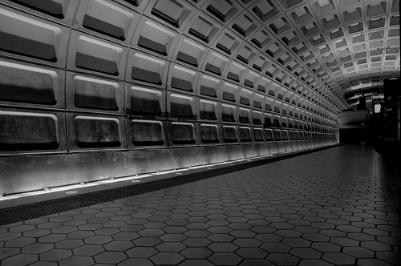
Picture taken by brents pix.