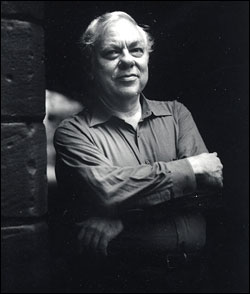
 The 40th season of the concert series sponsored by the Foundation for Advanced Education in the Sciences, which opened on Sunday afternoon with a recital by pianist Richard Goode in the relatively full Congregation Beth-El in Bethesda, will also be its final one. Dr. Giulio Cantoni, the founder of the series, passed away this summer, and Paola Saffiotti, the series’ guiding light in many ways, was diagnosed with cancer around the same time. For financial reasons independent of these events, but certainly not helped by them, FAES will instead give funding to the Monday lunchtime concert series on the campus of the National Institutes of Health. Unfortunately, the heightened security at NIH and the time of those concerts make it unlikely that many people who are not employees of NIH will attend.
Richard Goode last played in Washington this past February, and his current obsessions, which also dominated the 2005 Carnegie Hall recital (listen to it online via NPR), are Bach, Chopin, and Debussy. Beethoven, of course, has been a long-standing specialty. Goode created this excellent recital as a homage to Chopin, writing in his program essay that last fall he was “seized with a sudden desire to immerse myself in the music of Chopin. Suddenly, no other composer seemed as necessary or satisfying.” Opening with a set of pieces by J. S. Bach, Goode displayed his solid style of playing Bach, with a gentle, introspective G minor prelude and its accompanying fugue with the string of repeated notes in the subject (from Book 2 of the Well-Tempered Clavier).
Four Sinfonias, also known as the three-part inventions, included a whirring treatment of the E major, an understated E minor with clear delineation of voices, and tidy embellishments in a calm reading of the E-flat major. The best piece in the set was last, the B major prelude and fugue (Book 2, WTC), with a very fast performance of the toccata-like prelude and a starry, exalted fugue. Two sonatas by Haydn and Beethoven admittedly had little to do with Chopin, but the Hadyn D major sonata (Hob. XVI:24) especially was a delight. It is rare enough to hear Haydn played and even rarer to hear it played this well. The first movement was jolly and playful but with an admirable light touch, not buffoonish. With a skillful manipulation of dynamic contrasts, Goode unfurled all of the delicate whorls of rocaille decoration in the second movement and gracefully negotiated the triple-meter presto.