 No one who loves the piano would have missed Murray Perahia‘s sold-out recital on Sunday afternoon in the Music Center at Strathmore, sponsored by Washington Performing Arts Society. Perahia had to cancel his 2006 WPAS recital because of renewed pain from a thumb injury in the 1990s that nearly ended his career. Indeed, there were worries that we might never hear him play again. Happily, there he was, modest and unassuming, bowing politely and then sitting at the Steinway for a survey of music from his past triumphs and favorite composers. The joy of listening to Perahia is not only for his virtuosity, still in those hands if slightly faded, but in the endlessly subtle shading of each phrase and note.
The concert opened with Bach, music that some Perahia fans do not think suits him, but these ears have been fans at least since hearing his take on the Goldberg Variations, one of the best versions on piano. In this case, it was a stylistically sensitive performance of the fourth keyboard partita (D major, BWV 828). Although there were a few nervous-making finger slips in the dotted section of the French ouverture first movement, the fugal section was brisk and crisply marked, with a confident, lute-like rolled chord at the end.
The Allemande had a languid, porcelain sheen to it, but the Sarabande had a strong pulse. Rather than slowing down the entire Sarabande, Perahia singled out the quirky intonation with tail of the first couple bars of each section, slowing it down, letting it unwind but immediately resuming the pulse afterward. (The way that music is written — the high tessitura, the fivelet or sixlet that trails upward to nothing — disconnect it from what follows.) The sprightly Courante made a jagged gesture of the bubbling main rhythmic motif (the groupings of two sixteenth notes and one eighth note), and the Gigue was an impressive tour de force, its B section treated like a rattling moto perpetuo.
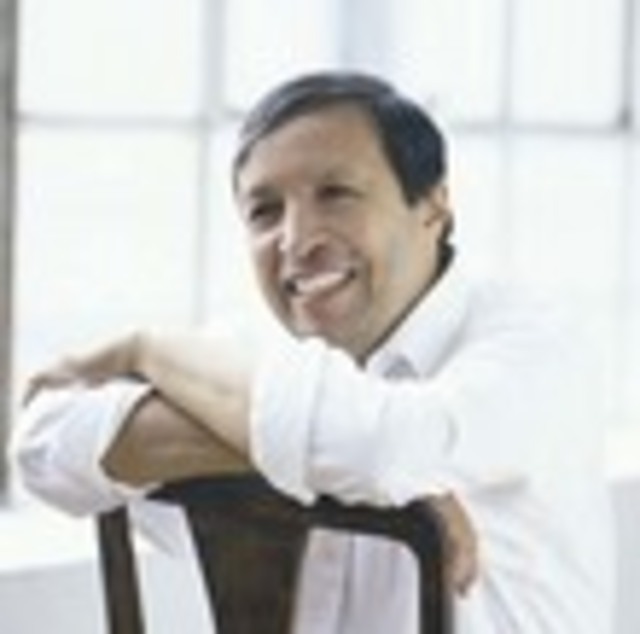
Photo of pianist Murray Perahia by Watanabe, courtesy of Sony Classical