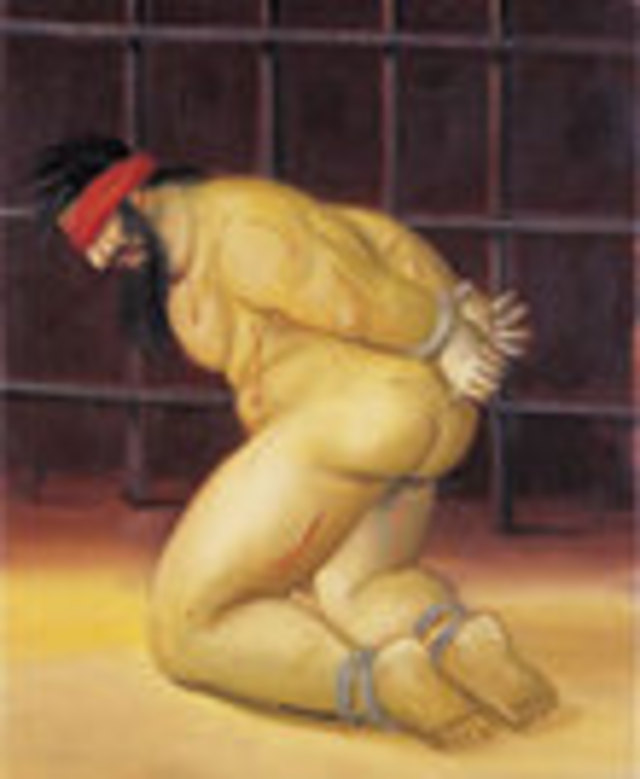
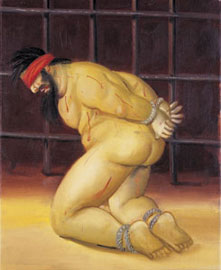
 In an audacious presentation of political and protest art, the Katzen Arts Center’s Art of CONFRONTation showcases three separate exhibitions that share a confident outspokenness. Whether it’s the poignant reenactments of torture of Abu Ghraib by Fernando Botero, or the surreal depictions of the city-dominated human condition by Irving Norman in Dark Metropolis, or the multifaceted collection of some of the 1970s most important feminist art in Claiming Space, these works are united by a passionate and irrepressible yearning to speak and be heard.
Despite their similarities, each exhibit has its own floor in the Katzen Arts Center—whose curved walls and pointed hallways make it a perfect venue for such a dynamic collection—so viewers are able to see each one independent of the others.
Start on the top (third) floor, where you’ll find Botero’s 79 Abu Ghraib paintings and drawings. Seen around the world, this is the first time the whole collection will be presented in the U.S., where Botero has had considerable difficulty getting museums to take on the controversial collection. He started working on the project as an outlet for the anger he felt after reading Seymour M. Hersh’s 2004 article on the now infamous torture there. Botero explained that he became “obsessed” with Abu Ghraib, saying, “the more I painted, the more the feelings came.”
The works are filled with emotion. Blood is everywhere. The colors are grotesque and bring to mind the color skin assumes when afflicted with gangrene or jaundice. Grimaces form on the inmates’ faces and pain is ubiquitous. Yet perhaps the most interesting aspect of the works is the absence of guards. “Whenever you see or hear about a crime you feel sympathy for the victim,” Botero explained, “not the perpetrator.” In fact, Botero was so taken by his work he said he didn’t even realize the guards’ absence until after the collection was finished.