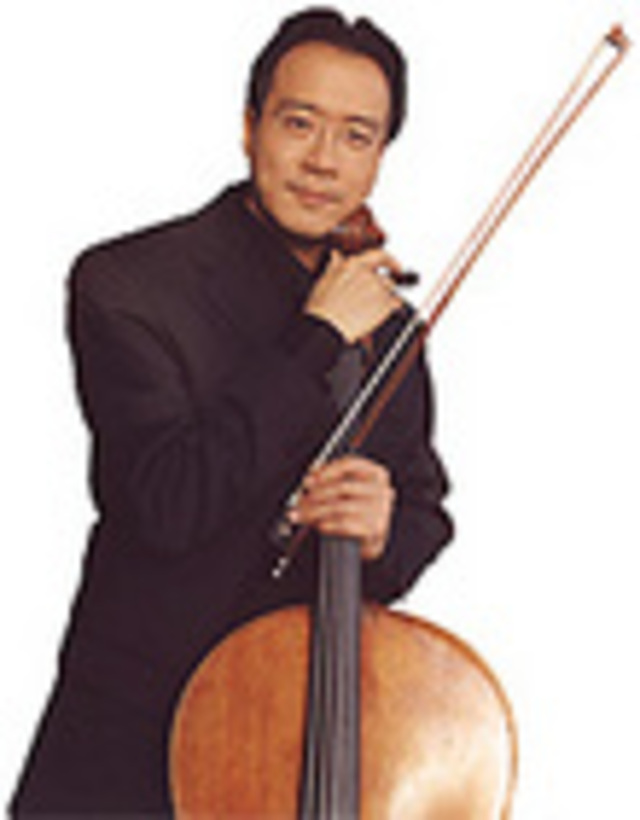
 As Washington Performing Arts Society President Neale Perl pointed out, Monday evening’s recital at the Kennedy Center was cellist Yo-Yo Ma’s 23rd appearance sponsored by the organization. WPAS returns again and again to someone like Ma, not only because one can be reasonably assured that he will deliver a fine recital but also because he can sell out a space like the Concert Hall, even though it is arguably too large for the sort of performance he will give. As the evening was also the occasion for the WPAS Fall Celebration gala, with the concert as its centerpiece, Ma offered a selection of some of the greatest hits from his prolific discography.
It was all beautifully played, with an emphasis on ethereal sound and gentle rather than forceful interpretation. The opening of Schubert’s sonata for arpeggione (A minor, D. 821) set the tone, almost too soft to be heard, followed by a subtle folk accelerando on the second theme. The second movement showed off Ma’s luscious, broadly shaped legato, full of ardor. If Ma has a weakness, it is an avoidance of rawer, bravura sound, as in the spiccato passages in the third movement. English pianist Kathryn Stott, who has partnered with Ma on recent recordings (instead of Emanuel Ax), was technically proficient if perhaps too subservient to her more famous counterpart.
The high point of the program was the gloriously decadent Shostakovich D minor sonata, op. 40, a piece that the average listener would not identify as belonging to the dreaded, dissonant oeuvre of the modern era. Ma’s reading seemed to take off from where the Schubert ended, in long-lined lyricism and a first-movement tempo definitely on the non troppo side of Allegretto. The scherzo was a danse macabre of skeletons and machine-gun motifs, while the somber folk recitative of the third movement featured a piano interlude of graveyard bells. The fourth movement’s turn toward the more bitter tone often associated with Shostakovich was communicated well, especially in the spiteful, ultrafast dance-like section. The first half probably should have ended there, but the duo pressed on with a movement from Astor Piazzolla’s Tango Suite (no. 4, Le Grand Tango), an extremely appealing work that is more or less the Argentinian equivalent of Ravel’s La Valse. The tone was tragic but intensely contained, exactly the mood of the tango.