
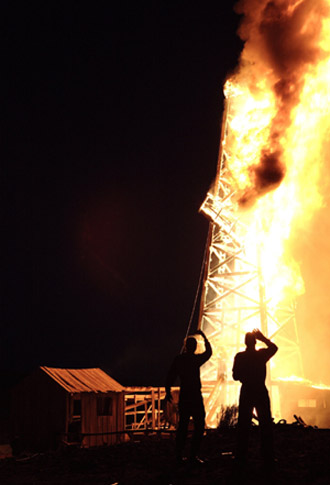
 “I can’t keep doing this on my own, with these….people,” laments Daniel Plainiew, midway through Paul Thomas Anderson’s latest film. That final word, “people,” tumbles out of Daniel Day-Lewis’ mouth like a piece of sour meat, rotting and foul-tasting. It’s a defining moment for his character: as far as he’s concerned, people are just no damn good. The problem is, he’s just as much of a bastard as the rest of them. And try as he might to remove everyone else from his life, he can’t quite escape his own tarnished shadow.
Plainview is a relentlessly self-made man. The film’s masterfully executed opening sequence runs for ten almost completely wordless minutes. In it, Anderson shows Plainview’s rise from shabby, bearded prospector searching for the smallest scrap of precious metal all by himself in deep and dangerous mineshafts, to self-proclaimed “oil man”. The holes he graduates to are still dark and deadly, but the rewards are now far greater. Along the way, he picks up a son, orphaned by one of his own oil wells. He displays a great deal of what appears to be love for the boy, until the point when the child no longer becomes a business asset. Plainview is a liar, a cheat, a raging alcoholic. Day-Lewis, in a performance of unbelievable intensity, imbues him with a grasp of sanity that is only just barely controlled. That Anderson can build such a towering and engaging epic around such a distasteful character is just one of the many brilliant mysteries of There Will Be Blood.
Anderson’s vision is uncompromising and razor sharp. Nothing in his first four features quite prepares us for the precision and vicious wit displayed here. While his previous films have a flair for epic tragedy (with the exception of the bizarre love-story of Punch Drunk Love), and a mastery in their creation of a uniting mood and atmosphere, they have a certain showiness. In TWBB, there is a confidence and a grace that seems effortless. Anderson disappears within his film just as surely as Day-Lewis and Paul Dano disappear within the respective madness of their characters.