
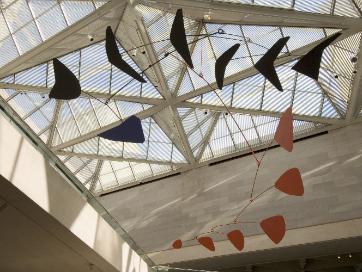
 One can hardly visit the East Building of the National Gallery of Art without noticing the large mobile by Alexander Calder soaring over the atrium. The mobile, Untitled, was designed specifically for this space, and Calder utilized new materials and methods to make the piece, which is visually both powerful and delicate.
In the early 1970s, the Board of Trustees at the National Gallery commissioned the East Building, which would be dedicated to modern art. When they thought about decorating the new space, they decided to ask the most celebrated artists of the moment to create pieces. Calder was included, since he was known for his work in the 1920s and 1930s, making kinetic sculpture filled with humor. He was commissioned on May 3, 1973 to design a sculpture for the atrium, and he worked closely with architect I.M. Pei to ensure that the mobile would complement the design of the building.
Calder was a renowned American sculptor who worked primarily with steel, a material that would be too heavy for a work suspended in the atrium. His interests in space, engineering and technology led him to honeycombed aluminum, a light yet durable material originally developed for aeronautics, which would respond effectively to air currents, a characteristic that would befit a mobile.