Martin Austermuhle
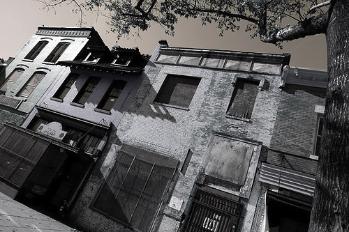 It’s hard to look down H Street NE and imagine that it was ever a bustling corridor. But along with Fourteenth Street NW and Seventh Street NW, it represented the center of the District’s African American commercial presence in the years during which the U.S. struggled to overcome the legacy of state-sponsored segregation. It was the events of April 4, 1968 that decimated all three of those streets and the African American businesses that anchored them, leaving behind a legacy that the District is only emerging from today.
It was forty years ago today that Dr. Martin Luther King, Jr. was felled by an assassin’s bullet in Memphis, news that provoked riots in at least 110 cities across the country. In the District, huge crowds gathered in the city’s African American neighborhoods, leading a campaign of looting and destruction that burned over 1,200 buildings, including 900 stores. Hardest hit were H Street NE, Fourteenth Street NW, and Seventh Street NW. The angry crowds, at times surpassing 20,000, easily overwhelmed the city’s police forces, leaving President Lyndon B. Johnson to dispatch 13,600 federal troops, including 1,750 from the D.C. National Guard. When it was all said and done, over 6,100 people had been arrested and damages totalled $27 million.
Today the three corridors are at different stages of rebirth. Fourteenth Street NW is more and more lined with bars, condos, and coffee shops, while Seventh Street NW runs alongside the massive Walter E. Washington Convention Center (named after the man who was mayor of the District at the time of the riots, no less). And though it lags behind, H Street NE is home to the up-and-coming Atlas District, and city officials see promise in the commercial corridor. But the renaissance of the three isn’t without difficulty. The District remains starkly divided — a segregation of sorts — and these three corridors have seen pitched battles over gentrification, displacement and development. While it’s easy to look down Fourteenth Street and celebrate its improvements, it’s hard not to recognize that while the riots may have helped kill the original African American commercial presence, government policy since and our own individual actions have helped bury it.
In remembering Dr. King’s killing and the riots that it set off, we can turn to some of the people that were alive at the time to witness it. Over at the Washingtonian’s site, African American leader Virginia Ali and novelist George Pelacanos remember the riots and their impact; longtime activist Sam Smith shares his own story over at D.C. City Desk; over at the Post photographer Matthew Lewis discusses his pictures of and reaction to the riots; while Reuban Jackson remembers hearing the news as a child over at Prince of Petworth; and at The Root Alice Bonner talks about the “righteous chaos” of April 4, 1968.
Photo by mparas