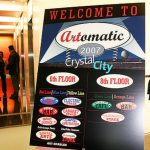
Despite eight full floors filled with the work of over 800 visual artists, a slew of stages prepared for musical, dance, theatric, and 200 other performing artists, it’s good to remember that Artomatic, which opens today, is about a lot more than “art.”
The community-driven, all-volunteer exhibition has been holding court for local artists on-and-off since 1999. This year’s show, held at the new Capital Plaza I building at 1200 First Street NE, is by far the biggest they’ve ever undertaken. Artomatic worked in conjunction with the NoMa Business Improvement District, founded barely a year ago, to find the venue and use the show to highlight the neighborhood as an up-and-comer. Predicting 50,000 visitors over the five week run, all parties hope folks will visit NoMa for first time and see the potential it wants to be known for as a grand commercial district between Capitol Hill and Eckington. The relatively new New York Avenue Metro helped ATF decide to establish new offices there, with NPR Headquarters, some Department of Justice offices, and a Harris Teeter all moving in soon, as well. Liz Price, head of NoMa BID, noted the great effort being put in to bring in retail, restaurants, green design, parks, and, of course, public art to the neighborhood.
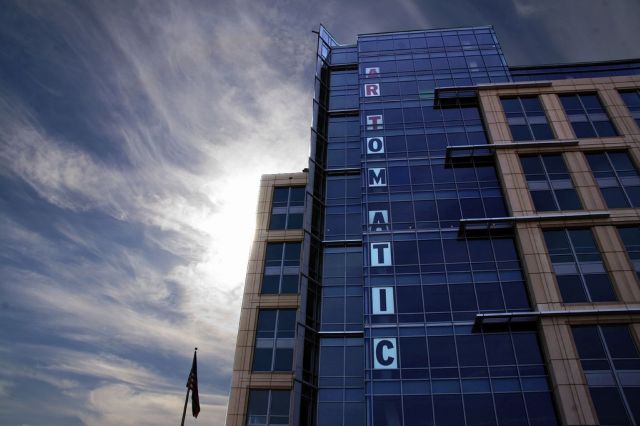
You’ll have to squint real hard though, because the neighborhood has a long way to go, featuring Gallaudet University and… not much else. In fact, you can see the 12-story Artomatic building from the Metro, over a square-block-sized gaping hole of construction. Potential, however, is something that Artomatic was born for. With each exhibition, volunteers descend upon empty commercial space and make it a living and breathing thing. Local artists benefit for obvious reasons, while the owners of Capital Plaza I hope that potential tenants come calling to see the space while its abuzz with excitement.
As for the show itself, we have to agree with Del. Eleanor Holmes Norton, who spoke at this morning’s press event.
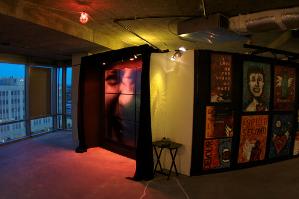 “Artomatic reminds us that this is a hometown, not a government town…and we refuse to be defined by the monuments, and certainly not by Congress,” Norton said.
Artomatic consistantly gets a bad rap for being non-discriminating and over-inclusive. And it’s certainly true that some — well, perhaps more than some — of the art is really, really not good, and that only a person with superhuman patience could get through all eight floors of art in one visit.
But Norton has it spot-on. If you’ve witnessed any of the run-up to Artomatic, whether it was the massive volume of the emails sent out, or friends expressing their joy and sometimes near hysteria about their involvement in the show, from picking their wall paint color to sending out reams of invitations, you know that the show generates an excitement about creativity and do-it-yourself community ethic like nothing else in this town. In addition to preparing their own exhibition space, which includes lighting, hanging, and often working with exhibit neighbors when logistical problems arise, each artist must also commit 15 hours to running the exhibition over the five weeks. There is no dumping your art off at the doorstep and waiting for the gallery owner to call you when there’s a sale. Visitors are almost guaranteed to meet a large percentage of the artists at their booth during any night you attend the show.