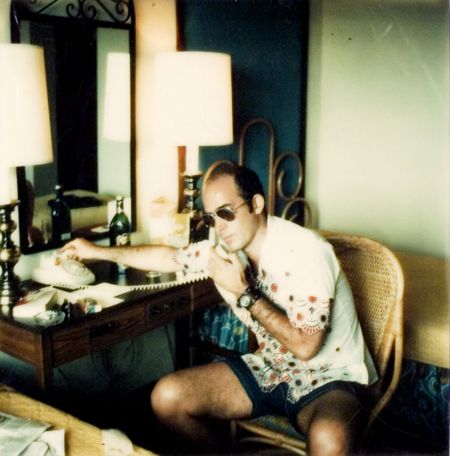
 Director Alex Gibney (who we interviewed earlier this year) is making a mounting case for a future legacy as the first great documentarian of the 21st century. Hot on the heels of his incisive investigations into the collapse of a major corporation and the collapse of America’s wartime moral compass, Gibney has switched gears. Rather than going after an entity whose misdeeds he feels are in dire need of being exposed, he has made what will likely be seen as the definitive filmed biography of the life of someone who was similarly dedicated to exposing the sleaze of the evildoers: Dr. Hunter S. Thompson.
Gibney is, on the surface, an odd choice to document Thompson’s life. Thompson’s reckless life, the barely controlled mania of his writing, and the absolute hilarity of his drug-addled takes on his subjects seems the polar opposite of Gibney’s now-familiar sharp-edged, sober, and mirthless films. But beneath the surface, both men are fueled by the same righteous indignation, and the controlled burn of the director’s fire turns out to be the perfect delivery vehicle for looking at the wildfire that was Thompson’s life. Not to mention that Thompson’s story is in many ways just as much about a collapse as Enron or Taxi to the Dark Side.
Gonzo compiles an astounding volume of material to make up a portrait of the writer; Gibney was given access to the entirety of Thompson’s estate, including reels and reels of home movies and video, hours of tape of interviews and dictated thoughts. The rush of images is staggering, as the filmmaker combines all this footage with archival bits, scenes from previously released documentary and dramatized films about Thompson, and the occasional staged image, all choreographed to an excellent soundtrack of popular (and always relevant) songs that are becoming a recognizable hallmark of Gibney’s work. While overwhelming, the film is beautifully structured, the only major misstep perhaps being an overabundance of footage from Terry Gilliam’s film of Fear and Loathing in Las Vegas during the discussion of the book’s original writing. As true to the spirit and text of Thompson’s writing as Gilliam’s film was (and as underrated a gem as it is), Gibney almost begins to treat the movie as archival footage of Thompson’s Vegas trip, and goes a few paces too far.