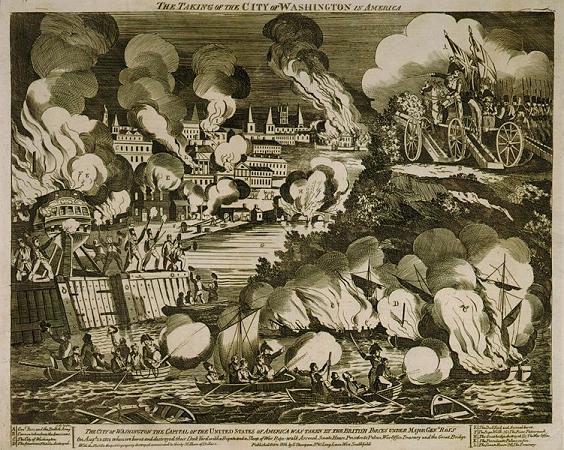
Because it’s August and there’s no new local news, we thought we’d take a moment to turn back the clock and look at a big day in our city’s history. On August 25, 1814, the War of 1812 took a turn in the newly-minted nation’s capital, when troops set fire to Washington, D.C. The war started when the British Empire restricted U.S. trade with France (who Britain was also at odds with). Being the take-no-bullshit-little-upstarts that we were, we declared war on the mother land. In retaliation to our ill-fated (and pyrotechnic-filled) attempt to invade Canada at the Battle of York, British forces set fire to the public buildings of our young city — the Senate and House of Representatives, the Library of Congress, the United States Treasury and, most notably, the White House. The British commanders gave strict orders that the fires only be set in public areas — an effort that saved most of the city’s residences. D.C. made an effort to fight back with the limited numbers available to us, and attacked British forces at the corner of Maryland Avenue, Constitution Avenue, and Second Street NE. That attack set the tone for the upcoming blaze:
Such being the intention of General Ross, he did not march the troops immediately into the city, but halted them upon a plain in its immediate vicinity, whilst a flag of truce was sent in with terms. But whatever his proposal might have been, it was not so much as heard, for scarcely had the party bearing the flag entered the street, than they were fired upon from the windows of one of the houses, and the horse of the General himself, who accompanied them, killed. You will easily believe that conduct so unjustifiable, so direct a breach of the law of nations, roused the indignation of every individual, from the General himself down to the private soldier.
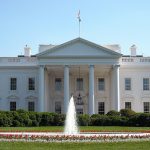
When the White House burned, only exterior walls remained, most of which ultimately had to be reconstructed. British troops ransacked the presidential residence, taking countless artifacts — only two of which have been recovered. Badass first lady Dolley Madison stayed after everyone else had abandoned the White House to rescue the famous Lansdowne portrait of President George Washington, and decades later a Canadian man returned a jewelry box to FDR, claiming his grandfather had stolen it from the White House in the raid.