 Washington National Opera opened its fall season on Saturday night, with an ultra-conventional but visually lavish production of Giuseppe Verdi’s classic La Traviata. One of the so-called Big Three from the ground-breaking middle of Verdi’s operatic career, the opera’s libretto by Francesco Maria Piave, a poet so compliant that he became a sort of punching bag for the composer, is a miracle of dramatic concision. In this opera, you can actually watch Verdi forcing the conventions of Italian opera that he inherited — the cavatina, the cabaletta, the banda, the toast scene — to bend to the telling of a story. That story, about a courtesan who finds love outside of society’s moral strictures and is punished for it, also resonated personally with Verdi. A widower, he resented the criticism he received from his contemporaries for living with the soprano Giuseppina Strepponi before they were ultimately married.
This production was billed essentially as a vehicle for soprano Elizabeth Futral, a familiar and beloved singer among Washington audiences. She has been very impressive in bel canto repertoire like Rossini’s Siege of Corinth in Baltimore and Otello with Washington Concert Opera, and especially her frothy Adina in Washington National Opera’s L’Elisir d’Amore. Her Violetta, not surprisingly, was in a similar vein, with pyrotechnical fioriture in the Act I brindisi and a radiant high note added to the end of Sempre libera (the piece chosen, not coincidentally, for the publicity video embedded after the jump). However, Verdi made the role not only like Adina but also called for a stronger low range and a heavier lyric and spinto quality. These things Futral just does not have, and it puts the role just out of her reach, vocally speaking, although her slender figure made her one of the most dramatically convincing Violettas, an elegant counterpart to the vamp brought to life by Anna Netrebko in Salzburg.
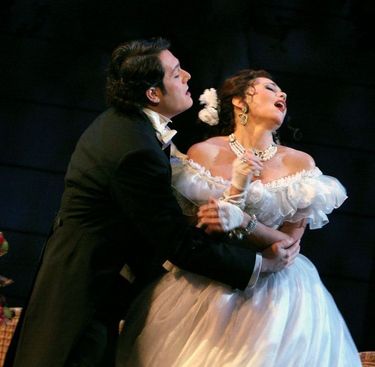
Arturo Chacón-Cruz (Alfredo) and Elizabeth Futral (Violetta) in La Traviata, Washington National Opera, 2008, photo by Karin Cooper