 With the National Museum of the American Indian already on the mall, art that represents the American Indian doesn’t often show up at other local museums. But George de Forest Brush: The Indian Paintings, a National Gallery of Art show that opened this weekend, presents insight into both the work of an obscure painter and into 19th century Native American life.
Brush grew up in Brooklyn and Connecticut, and is not a Native American. He studied painting in New York and Paris, and in 1882, traveled to Wyoming and Montana, where he lived on a reservation. A year later, he returned east and began to teach and paint.
The exhibit consists of 21 paintings juxtaposing life studies of men from Arapahoe and Shoshone tribes to studio paintings that offer an outsider’s view into the range of activities that comprised Native American life.
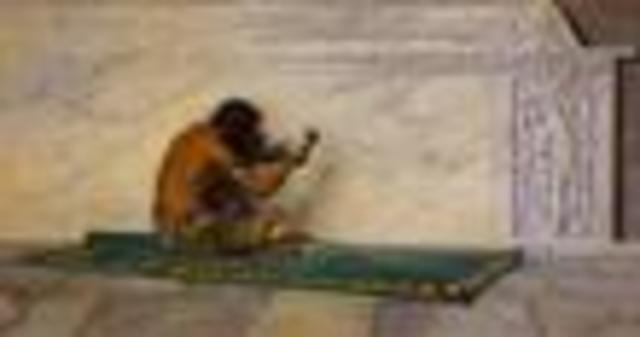
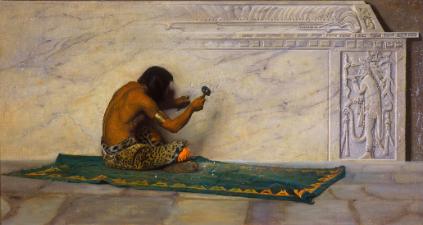
The show was partly inspired by the rediscovery of 1887’s An Aztec Sculptor, (above) which was lost for a century, and is one of the most impressive works on display. The painting features a sole figure, hunched over and sitting a turquoise rug on the floor, next to a wall of marble. He chips away at the wall, adding to an intricate design. An Aztec Sculptor, like several other Brush works, implies the artist’s skepticism about industrialization, and his worry that native crafts and traditions would be lost.