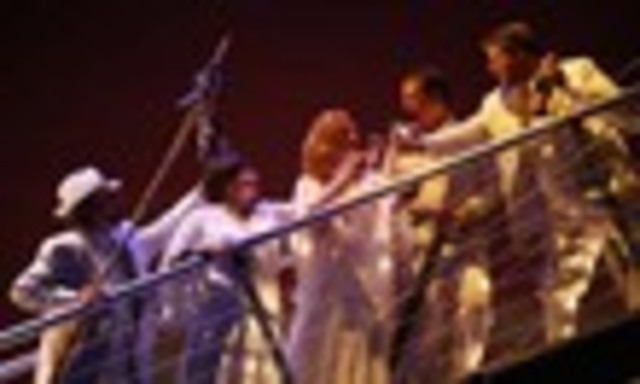

The Gods cross the Rainbow Bridge into Valhalla in WNO’s Das Rheingold (Photo: Karin Cooper)
You know that the financial crisis has already caused a lot of damage to the lives of everyday people, as companies go into bankruptcy and people lose their jobs and mortgages. The corresponding cultural damage is beginning appear as well: regional opera companies and symphonies are folding, while others are cutting back their projected seasons for fear of being unable to fill the house. The National Symphony Orchestra was recently able to secure a large financial gift to underwrite hiring Christoph Eschenbach as its new Music Director, but other arts organizations are losing donor pledges left and right. As Anne Midgette and David Montgomery have reported in the Post, one of the casualties is the projected complete performances of Wagner’s legendary Ring cycle, planned by Washington National Opera for November 2009.
We have been following the progress of the company’s American Ring Cycle, with one of the four operas being staged per season. Francesca Zambello’s concept was to take Wagner’s operatic setting of old Teutonic legend and use instead imagery from American history and mythology. As became clear in Das Rheingold in 2006, Zambello conceived in terms of the American wealthy class, a family of corrupt business barons. Wotan builds their version of the American dream, a vast McMansion that will be their new home, without really knowing how he will pay for it. The lower races of creatures on the Earth are presented as their playthings, the Nibelungs cast as African-American slaves and, in Die Walküre, Sieglinde and Hunding like prairie homesteaders. The irony that this project was made financially impossible by the excesses of deficit spending that caused the current financial crisis is too delicious to ignore.
Siegfried, already delayed a year from last season to this May, will be staged as planned, but the final opera of the tetralogy, Götterdämmerung, will receive only two concert performances. Not putting on all four of the operas at the same time, a very expensive venture, will save the company $5 million to $6 million, at a time when it will be difficult enough to pay for a normal season. Some of the singers already contracted for the complete Ring will instead perform in a revised season for next year, now set to include Ambroise Thomas’s Hamlet (with Diana Damrau), Mozart’s Le Nozze di Figaro, and a revival of the 2005 Porgy and Bess. No one can blame WNO for covering itself in an uncertain period, but the complete Ring cycle, a first ever for Washington, D.C., would almost certainly have been the most glamorous and internationally newsworthy operatic event in the company’s history. It is hard not to mourn its loss, even if it does turn out to be only temporary.