
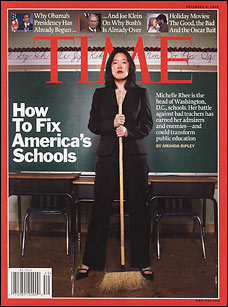
 Since D.C. schools chancellor Michelle Rhee hit the cover of TIME Magazine last week, our “Michelle Rhee” Google alert has been blowing up — there is something about Rhee that gets people’s attention and elicits a response. Take this quote from the TIME story:
“The thing that kills me about education is that it’s so touchy-feely,” she tells me one afternoon in her office…”People say, ‘Well, you know, test scores don’t take into account creativity and the love of learning,'” she says… “I’m like, ‘You know what? I don’t give a crap.’ Don’t get me wrong. Creativity is good and whatever. But if the children don’t know how to read, I don’t care how creative you are. You’re not doing your job.”
People react to that kind of talk, whether in agreement or disgust. And while the TIME story didn’t contain much that we didn’t already know about Rhee, its cover portrait, which we wrote about this weekend, was a case in point for the subjective kinds of responses she garners. Rhee, dressed in black, holding a broom, struck some as an all-too-accurate witch comparison, others as an appropriate illustration of her “sweeping change.”
Kevin Carey, on the blog The Quick and the ED, had a different response to the TIME cover, objecting to its title, “How to Fix America’s Schools.” He writes:
“The educational challenges in DC are unusual and, compared to most districts, extreme. The needed changes are of commensurate severity. Seeing DC as the definitive proving ground for larger questions about tenure, management style, etc. is not going to serve anyone’s interests in the long run. The issues themselves will become over-politicized and thus harder to solve. And inferences drawn about what makes sense for other districts will be distorted by the differences with DC.”
Carey’s right – DPCS is a special case for a number of reasons, starting with the fact that the city itself is a special case. And while some of the issues being debated in D.C. right now will certainly impact decisions being made in other urban districts, it would be a mistake to assume that reforms undertaken in D.C. would have the same effect elsewhere, or that Rhee’s managerial style would be tolerated were she not a mayoral appointee.