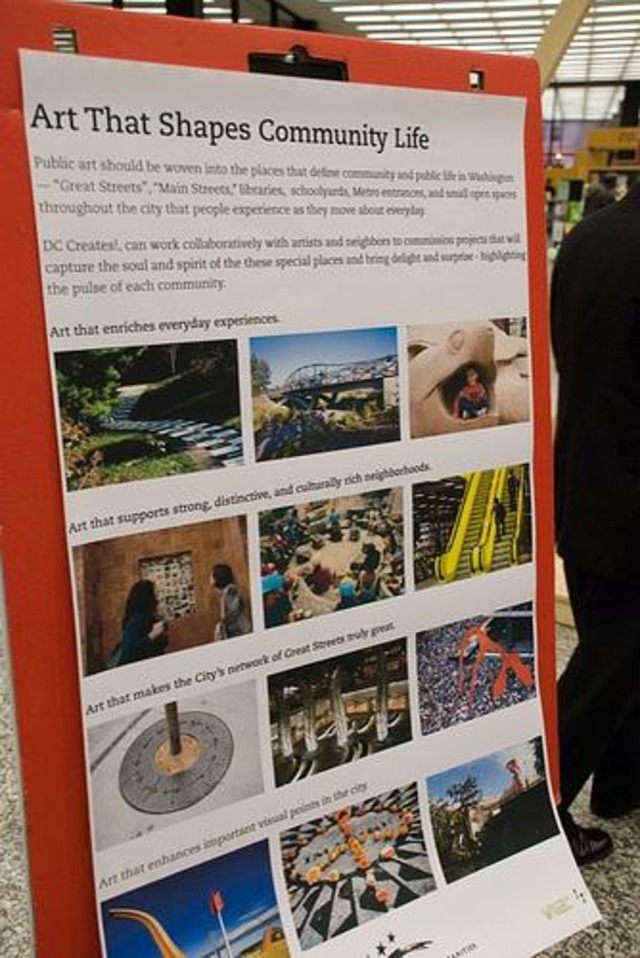
Last night the D.C. Commission on Arts and Humanities held a meeting in the Martin Luther King, Jr. Library to solicit opinions regarding public art in the city. DCCAH hired consultants (Via Partnership and Todd Bressi, an urban planner) last summer to research and present a five-year plan to identify locations, projects and collaborations that would most benefit both the residents and visitors of D.C. Last night’s meeting invited city residents to come and interact with advocates of public art, with the goal of developing new ideas and hearing what citizens want to see.
Since August, the consultants — along with a 40-person advisory panel and the commissioners — have met with various groups to discuss these issues. Gallerists, developers and artists have all gotten face-time with the group (we hear they’re meeting with the Black Artists of DC this afternoon). In the past few months, the consultants have identified three main goals to work towards when creating public art:
- Art in Places that Shape Community Life
- Art that Advances the City’s Greeen Agenda
- Art that Celebrates the City’s Creative Economy
The consultants are trying to identify special places in the city, such as historical districts, highly-trafficked pedestrian areas and “hearts” of neighborhoods, which would most benefit from the placement of public art. Sondra Arkin, a local artist and advisory panel member, said one particularly interesting suggestion included putting more local art on the National Mall for visitors to enjoy in between Smithsonians. They’re paying attention to include all eight wards, and may also lengthen the time for calls for artists, which, right now, often gives artists only a few weeks to put together a massive pubic art proposal.
Emily Blumenfelt, with Via Partnerships, said that D.C. is in an unusual position when it comes to our public art funding. Most cities get their art budget tied to capital projects (e.g. money for a mural included in a new stadium budget), but in D.C., the Commission on Arts and Humanities just gets a lump sum they can spend however they like. This gives the city a huge opportunity to be flexible and experimental, but, as Blumenfelt also noted, creates other missed opportunities when the DCCAH isn’t called in on a new city project. Their mission is to create a balance and take advantage of the wide-range of projects available, including becoming more visible to developers and urban planners.