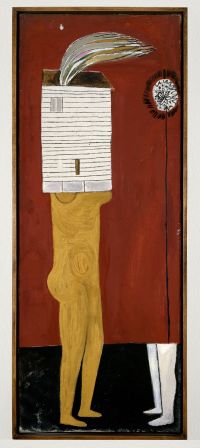
 Louise Bourgeois, “Femme Maison,” 1945-47, Private Collection. Photo: Eeva Inkeri
As an artist looked on as a leading figure in 20th century art, Louise Bourgeois has enjoyed an incredible 70 year career. From her early influences of Surrealism to her Feminist works, Bourgeois uses memory and emotion to create thought provoking motifs and dramatic sculpture. At the Hirshhorn Museum and Sculpture Garden, Bourgeois’ lengthy and successful career is highlighted in a major retrospective of her work.
From her early paintings created in the 1940s to her larger cell sculptures created in the 1990s, Bourgeois’ use of material is numerous and versatile. The show contains over 120 paintings, drawings and sculpture and showcases her work done in plaster, bronze, marble, wood, resin, latex and found objects. It is the exhibition’s last stop on a five city tour and boasts a few works by Bourgeois that were not previously included.
While not an exhaustive collection of her work, nothing seems to be missing from this retrospective. All of Bourgeois’ known works and themes are contained and given a thorough display to showcase her evolution as an artist. The retrospective also pays homage to the artist’s tendency to revisit imagery and themes, as many symbols and motifs reoccur throughout her career.
Starting with her early works, titled Femme Maison, the exhibit introduces Bourgeois’ musings on gender and the house as symbol. This series of paintings and drawings of women’s bodies topped with houses for heads, were created in the mid- to late-1940s. Their interpretation plays to both sides of gender roles, either upholding the notion of women’s domestic role at the time, or rallying against it. The theme of gender and the house as symbol are both reoccurring subjects that play out in her work.
One of her most striking and sometimes shocking series of sculptures that taunts gender lines is Fillette. Included in the exhibit is Fillette: Sweeter Version (1968-99), a hanging latex and plaster phallic piece. The sculpture teeters on realism with the base ending in two spheres that resemble testicles but could be seen as breasts, further blurring gender lines. These shapes are also found in other works such as Cumul I (1969) and Noire Veine (1968) evoking both sex and gender.
The Blind Leading the Blind (1947-49), is a sculpture from the Hirshhorn’s permanent collection that is made of a series of thin wooden sticks, lined up in two rows. Its placement within the retrospective gives the sculpture context among its sculptural siblings. Comparisons can be made between this work and Bourgeois’ other thin wooden sculptures called “Personages”; the similarities of her aesthetic can be readily seen in this body of work.