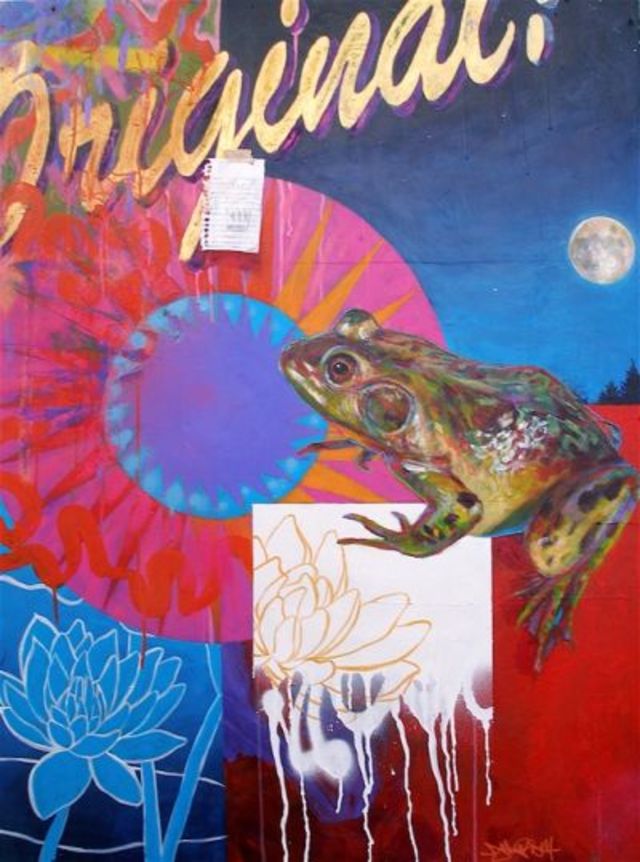
 Image of work by Adam Russell, courtesy Art Whino.
>> The 24-hour Drawing Project is back again this year, this time at Hamiltonian Gallery (it was at Warehouse last year). The group of artists involved will work on their own individual projects for the full 24 hours, though “drawing” can be interpreted loosely. Stop by to see them work from 9 a.m. to midnight tomorrow and 7 to 9 a.m. Saturday morning.
>> Tonight, catch a discussion with one of D.C.’s most sought-after performance artists, Kathryn Cornelius. Hear the history and philosophies behind her work, with some help from Arlington Art Center’s Jeffry Cudlin, from 6:30 to 9:30 p.m. at 1308 T Street NW. Sponsored by Meat Market’s Red Tape project and Curator’s Office.
>> On Saturday, the Corcoran Gallery of Art will open a new exhibition featuring Maya Lin. The artist and architect (yes, the one who designed the Vietnam Veterans Memorial) has constructed a number of installations as transformed landscapes. See a preview video of the exhibit here, and stop by the gallery Monday night for a screening of Maya Lin: A Strong Clear Vision.
>> New restaurant Eatonville, at 2121 14th Street NW, is currently a flurry of activity — a whole slew of artists are busy painting a mural to celebrate Harlem Renaissance author and folklorist Zora Neale Hurston. They’ll open the work to the public for a reception with the artist on Saturday from 9 to midnight, featuring DJs and performance artists ($10 suggested donation). Also open to view Sunday 10 a.m. to 4 p.m.
>> Art Whino opens Oneness Theories with paintings by Adam Russell, who “references the postmodern aspects of hip hop culture to assemble compositions based on a sampling and mixing of life’s imagery.” Opening reception Saturday, 6 p.m. to midnight.
>> Next Monday the Japan Information & Cultural Center will open Netsuke: Miniature Art in the Palm of Your Hand with over 50 pieces from a private collection. The history of netsuke reaches back 300 years, before the Japanese adopted Western fashions (the kind with pockets) and carried their belongings in small pouches. But just as the Japanese were opened to new styles once overseas trading began, the netsuke made their way to new lands and captivated foreigners. See the collection during their regular hours.