by DCist Tech Director Tom Lee
At just over ten thousand words, Larry Van Dyne’s Washingtonian article about the history of historic preservation in the District is indisputably thorough. But just about everything else about the article is up for debate. Despite his comprehensive accounting, Van Dyne is careful not to express an opinion of his own — although a reader will inevitably develop her own, if only because of the piece’s length. Faced with a list of preservation projects that somehow manages to include two steakhouses, even the most sentimental architecture fan could be forgiven for thinking that this all seems like a hell of a lot of historic preservation.
Of course, after an election season spent listening to the same stupid joke about grizzly bear DNA testing over and over, I’m hesitant to rely on this sort of context-free line item gotchas — maybe they really are particularly culturally significant steakhouses. But those buildings’ specific merits aside, it is easy to see how the impulse toward historical preservation can, or could, get out of hand. I’ve got some pack-rat tendencies myself: when faced with some piece of the cherished past — say, my groundbreaking first-grade report on armadillos — it’s never hard to come up with reasons why it would be nice to save it.
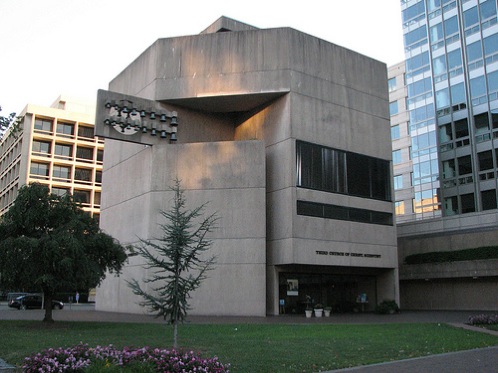
But this impulse can become problematic when applied to buildings. Not only are the immediate costs associated with preserving a building vastly larger than for other items of artistic or historical interest, but the future cost of preservation is often overlooked. Thanks to the city’s height restriction, D.C. is already unusually short on usefully-located building space. Writing off desirable plots of land like the one occupied by the Christian Science Church from contributing to the city’s economic, housing and social needs — forever, in theory — is a sufficiently extreme measure that we should approach it with extreme caution. Trading that much productive capacity for vaguely-defined cultural and aesthetic benefits ought to make anyone wary.
Photo used with permission under a Creative Commons license with Flickr user ElvertBarnes