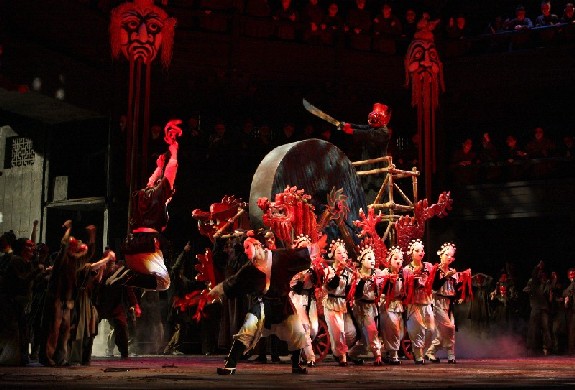
 Act I of “Turandot,” directed by Andrei Şerban, Washington National Opera, 2009 (photo by Karin Cooper)
After a spring season of more challenging operas — a vicious Peter Grimes and a controversial, Americanized Siegfried — Washington National Opera brought home the bacon on Saturday night, opening its final production, Puccini’s Turandot. The company presented this opera last time only in 2001 (with Alessandra Marc in the title role), and the Kirov Opera brought its road staging to the Kennedy Center in 2006. To answer the natural question — do we really need to see Turandot again so soon? — the company brought the colorful, somewhat slapstick, but still disturbingly savage production created by Andrei Şerban for Covent Garden 25 years ago (with none other than Plácido Domingo as Calaf) to Washington. Since most of the singing was quite good and the orchestra sounded in top form, this is indeed a production worth seeing.
Turandot (libretto in English or Italian) is set in an unspecified time in Beijing’s Forbidden City. The title character is a cold-hearted princess who refuses to marry unless a suitor can answer three difficult riddles. If he cannot answer the riddles, he pays with his head. A disgraced prince, Calaf, succeeds in answering the three riddles and, by further risking his life and the life of his aged father and devoted servant, forces Turandot to love him. Puccini went to great lengths to make his Italian operatic style as convincingly Chinese as he could, quoting Chinese melodies in the score and calling for a set of tuned Chinese gongs in the pit. Unfortunately, he died before he could finish the score of this, his final opera, and the moment where the completion of Franco Alfano takes over is marked in this production by a silent, solemn pause.