
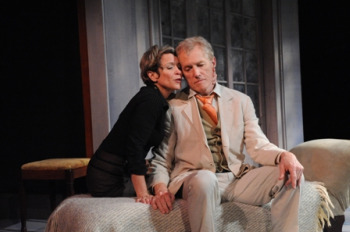
 Jacobson and Whiddon in “The Seagull.” (courtesy Theater J)
Written by DCist contributor Monica Shores
It seems that Theater J’s artistic director Ari Roth, who adapted Chekov’s classic The Seagull for the company, knows his decision to infuse the play with a Jewish crisis of faith may be a hard sell. Much of the printed program of The Seagull On 16th Street is devoted to justifying this choice, which stemmed from a need to square the play’s solidly non-Jewish content with a theater company whose mission is to explore “Jewish cultural legacy.” His logic is that The Seagull already touches on issues of faith (whether it be in the value of one’s artistic work, talent, or identity), so there’s no harm in throwing religious faith onto the pile.
It’s an interesting idea, but The Seagull is so dense a play in its original form, relentlessly exploring the unfulfilled desires of each character — primarily unrequited love — that the production threatens to buckle under the weight of more conflict.
The burdened Treplev (Alexander Strain) must struggle with his art, his selfish mother, his love for the neighbor, Nina, and now his Jewish identity. Perhaps it’s no wonder that Strain delivers such a hysterical performance, shoveling his lines at other characters and the audience as though he can’t unload them quickly enough, trembling and wheeling about the stage. Strain was last seen at Theater J as the “Tortured Genius” in The Rise and Fall of Annie Hall and similar inflections stray into his part here, namely a certain pomposity that makes it difficult to sympathize with his perpetual fragility.