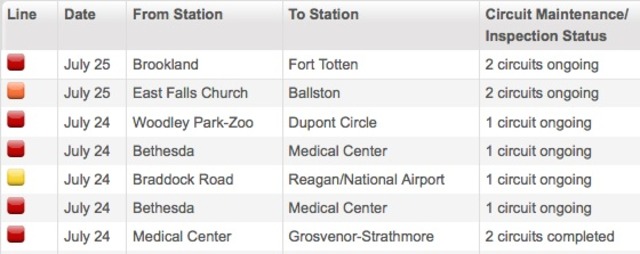
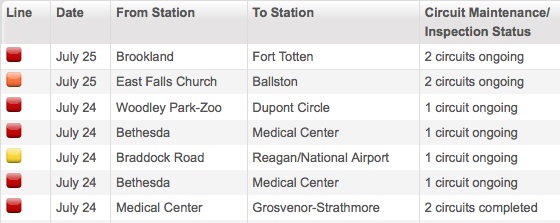
The larger Examiner enterprise may be pushing its online platform hot and heavy, but the local D.C. Examiner newspaper’s ability to integrate its stories on the web still leaves a whole lot to be desired. Take this story from this morning, with the headline: “Metro builds Web site about faulty track circuits.” You might expect to click through to the story and find contained therein the url, and maybe even (don’t get too radical now) a hyperlink to the web site that is the entire subject of this story. But no. Nowhere within the version of this story posted online do you find a single hint as to where you might find the actual web site it’s talking about. The editorial decision making process here is just bizarre.
Anyway, here’s the gist of the story:
Metro has created a Web page to alert riders daily of where it is working on problems found in its track circuits.
The move is an attempt to provide some openness to the system’s safety and operations after criticism of how it has handled information related to the June 22 crash that killed nine and injured more than 70 people. But the transit agency still has not been able to say how many circuits have needed repair under new testing standards established after the crash to give a sense of how widespread the problems may be.
We always say more information is better, so it’s hard to fault this move, even if it did come about more because Metrorail riders are so freaked out they are downright demanding more transparency, rather than because Metro naturally wants to act this way.
The actual url of this Track Circuit Monitoring and Maintenance is http://www.wmata.com/about_metro/track_circuit.cfm, and the page contains this explanation for what you can see there:
Since the rail accident on June 22, 2009, Metro has raised the standard for acceptable track circuit performance. As a result, we are checking circuits more often and that means, in some cases, trains need to slow down to a safe speed as they pass through areas where we’re working.
Engineers now review track circuit information twice daily, and if a circuit fails to meet the new standard, they dispatch a crew to inspect the circuit. When the circuit is inspected, and, if necessary, an adjustment or correction is made on the spot. If the circuit requires a more complex response, that circuit may be turned off, until the correction can be completed.
UPDATE:The Examiner’s Kytja Weir writes in to say they they’ve added a link in their online version of the story after reading our post about it. She blames a “tech problem” for its not being there in the first place.