The Smithsonian National Air and Space Museum has had quite the year so far. Last month they were visited by astronaut heroes from the beginning of the space race all the way through the latest space shuttle missions; they’ve continued to build out Phase Two at the Udvar-Hazy location, on track to finish in 2011; and will soon announce the opening, expected later this month, of their new Public Observatory on the Mall.
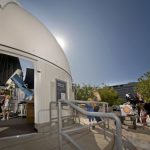
The Public Observatory is located just outside the museum’s food court on the Independence Avenue side (just before you enter the main doors, turn right and keep walking outside along the building). While it’s true that the middle of light-polluted, smoggy D.C. isn’t an optimal viewing location, the 1967 16″ Boller & Chivens, with its high magnification and long focal length, is perfect for viewing the sun (equipped with solar filters), moon and most of the planets even from the Mall.
Last Thursday, Dr. David DeVorkin, curator of the Space History Division, and Katie Moore, Director of the Observatory, gave an “Ask The Experts” tour, where DeVorkin explained that he conceived the idea when he attended the 2003 meeting of the International Astronomical Union. At the event, in addition to demoting poor Pluto from its planet status, they declared 2009 would be the International Year of Astronomy. Four hundred years after Galileo Galilei shared his discoveries from his telescope, the IAU has embraced his spirit with a series of events and projects all over the world to inspire people to look up and learn about the universe. For the museum’s part, DeVorkin decided to take advantage of the power that the Mall has in drawing mass amounts of people and, essentially, stick a big telescope in their way.
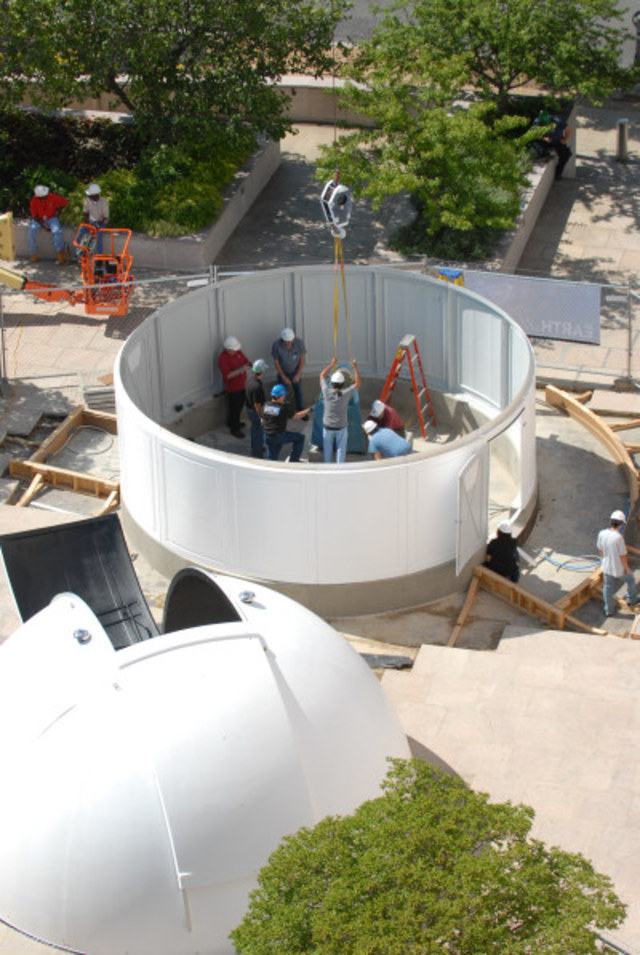
The scope is on a two-year loan from Harvard University (with the option for extensions), where it was kept in Oak Ridge Observatory, part of the Smithsonian Astrophysical Observatory until the venture was closed down a few years ago. It was very, very carefully taken apart and cleaned, divested of all the extra gadgets that astronomers had added to it over the decades, and then shipped to D.C. with the help of a high-end professional art shipping company. The observatory building was custom built in Australia before being disassembled and shipped over for installation. The 3,000 pound telescope and equatorial mount sits on a 4,000 pound cement support, which sits on top of 1.5 inches of a gel-like substance to reduce vibrations from nearby traffic. The dome was installed in July, and just one week ago they had “First Light,” the first time eyes peered through the scope in its new home.