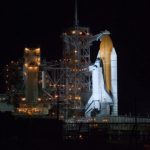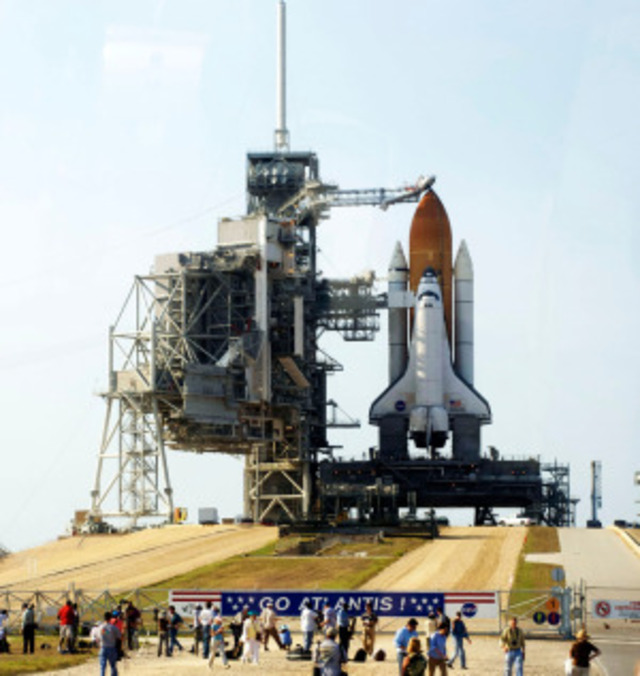
 Image of Atlantis the day before lift-off earlier this year; Tuesday’s launch will be of Space Shuttle Discovery. Photo by Heather Goss.
It’s a regular week of summer nights coming up. No meteor showers or amazing celestial events mark the calendar, but with the waxing Moon and (hopefully) some clear nights, it should be a great time to put on some bug spray and check out the regulars — start with the Summer Triangle we pointed out last week.
Sky & Telescope focuses on Jupiter, which is still visible almost all night. Find someone with a 4″ or larger telescope on Sunday night to see the Great Red Spot cross right over the planet’s midsection around 11:30 p.m.:
The “red” spot is actually pale orange-tan. It should be visible for about an hour before and after in a good 4-inch telescope if the atmospheric seeing is sharp and steady. A light blue or green filter helps. The Red Spot transits about every 10 hours 56 minutes; for all of the Red Spot’s transit times, good worldwide, use our Red Spot calculator or print out our list for 2009.
Then on Wednesday, check out the shadows of Jupiter’s moons, Ganymede and Europa, on the planet’s surface at 10:20 p.m.
For space fans, the big event this week isn’t visible from D.C., unfortunately. Space Shuttle Discovery is targeted to launch from the Kennedy Space Center at 1:36 a.m. on Tuesday. The astronauts of STS-128 are headed to the International Space Station to deliver, among other things, a treadmill named after the King of Stuffing Internet Polls, Stephen Colbert (or, the Combined Operational Load Bearing External Resistance Treadmill — ha! Those NASA guys can make an acronym out of anything…or anything into an acronym). NASA will air a message from Colbert on Monday evening before the shuttle launches. The three best places to view the launch online are NASA TV, SpaceFlight Now (with Miles O’Brien), and SpaceVidCast (for those who prefer their commentary from a sometimes very annoying pair of space geeks and accompanied by a chat room).