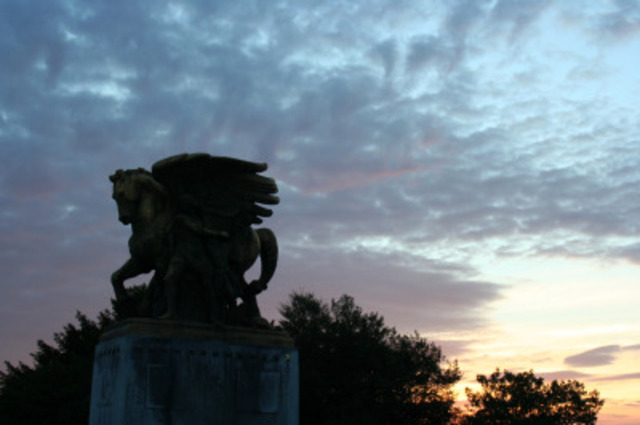
 “Sunset and Pegasus” by briankmoulton.
Autumnal Equinox
Tuesday, September 22 marks the autumnal equinox this year, ushering in turning leaves, chillier weather and, hopefully, lots of pumpkin pies, bread, and lattes. The equinox, as you well know, is one of two days each year that Earth’s axis is pointed such that the Northern and Southern Hemispheres are equidistant from the Sun. While we’ve been leaning in closer to the Sun for the last six months, our planet’s revolution will begin to take us farther away from the warming solar rays starting this week. If you’re a fan of totally bogus myths, get those eggs out — the exact moment of the equinox is at 11:09 p.m. EST.
Constellations
The beginning of fall also means we get a new slate of constellations to find in the sky. Watch Pegasus ride higher in the sky these days; this week you’ll find it near the horizon in the East after sunset. Find the big square/diamond that makes up its body, with its legs coming out of the star in the upper corner and its head coming out the right-hand corner.
Pegasus is often said to be saving “Princess Andromeda,” whose sprawled form is a V-shape coming out of the horses left-hand corner. Andromeda is an exciting part of our great big sky, because it points us to our nearest neighboring galaxy. On a clear night, you can see the Andromeda Galaxy, more formally known as M31, with your naked eyes. Start at the left corner of Pegasus, and follow Andromeda’s constellation line two stars going down and to the left. Here you’ll find the brightest star in Andromeda — actually a binary system, Alpheratz and Sirrah. From here, follow two more stars going straight up, and you’re almost there. The faint glow of the spiral galaxy is ever so slightly up and to the right of this star. With a pair of binoculars or any small telescope, you’ll even be able to see it in the middle of the city.