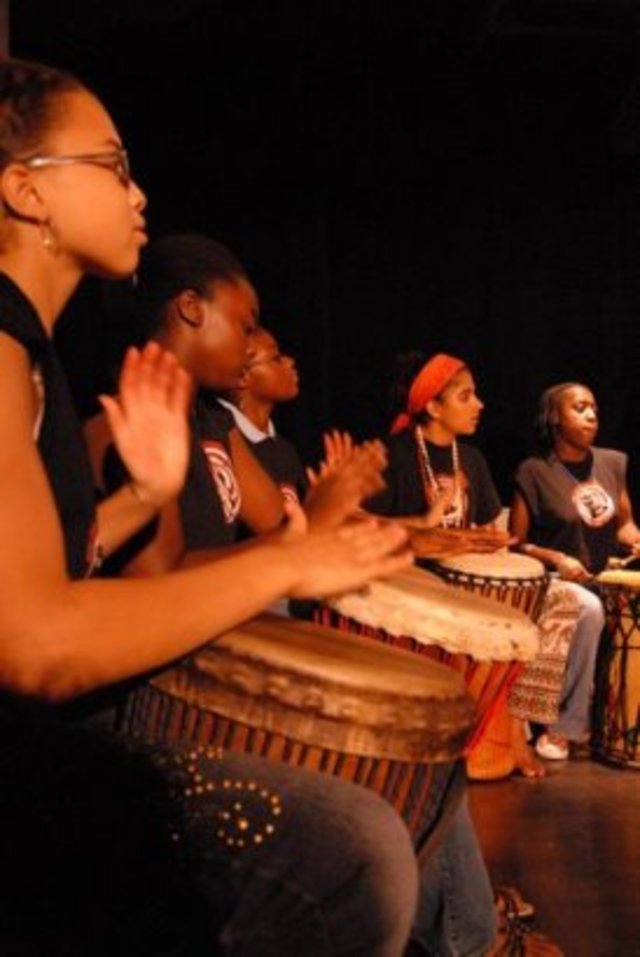
 Grateful Dead drummer Mickey Hart wrote in his excellent book, Drumming at the Edge of Magic, that “[w]ords are so inadequate at capturing the spirit of percussion.” One need only go to Malcolm X Park on any given Sunday to see the indescribable and spiritual effect drumming and rhythm can have on the receptive listener. Unfortunately, access to this experience is not universal. Any glance at a your average drum circle, high school marching band, or list of drummers at a music festival reveals a glaring absence: women.
Many still see female percussionists as a novelty, despite the trailblazing efforts of a few very well known players, and many more who are not so well known. Through some unfortunate combination of simple prejudice and deep rooted social mores, drumming remains “a man’s game.” But the problem is more than another example of gender inequity. The status quo means that women are denied the sense of self, and community, that drumming can instill more effectively than many other avocations.
“Drumming requires that one be completely present in that moment.,” said Kristen Arant, a local percussionist and performance artist. “In that way, it’s meditative, restorative, revitalizing and energizing.”
Arant is the co-founder and Executive Director of the Young Women’s Drumming Empowerment Project (YWDEP, pronounced why-dep). Arant herself discovered drumming during a period of flux in her own life. A music major during her early college years, Arant’s goals changed when she became an “impassioned” community activist. She was eventually given a drum as a gift, and its effect was transformative.
“[The drum] signaled a great shift in my life, basically the beginning of the end of my tragically low self esteem,” Arant said. “It served as an outlet for my depression and anger, for starters, along with a terrific accompaniment to street activism.”