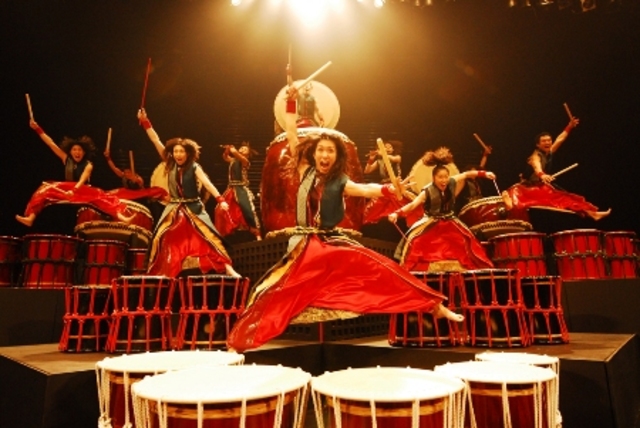
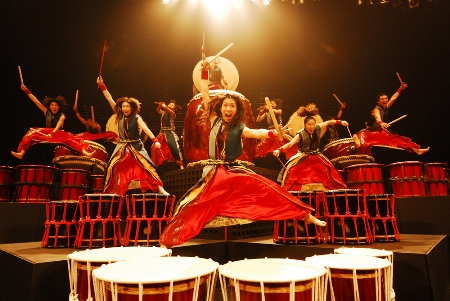
 Yamato.
In his book, Drumming at the Edge of Magic, Grateful Dead drummer Mickey Hart tried to capture the spiritual essence of drumming.
“In the beginning was noise. And noise begat rhythm. And rhythm begat everything else,” he wrote.
Hart’s words capture the primordial nature of rhythm, giving it an appropriate sense of antiquity. But rhythm isn’t a prehistoric concept. Drumming is central to so many musical traditions around the world, but it’s always a pleasure to see percussionists today that draw from that universal lineage. Yamato, a taiko drumming ensemble from Japan that is playing the Lisner Auditorium on Sunday, captures this aesthetic. The performance is quite literally connected to years past, as their instruments are made from trees that are often several hundred years old.
“We as Yamato members always treat Taiko instrument as a treasure,” said Masa Ogawa, the group’s founder and artistic director. “We are recognizing that God is inside of taiko.”
Taiko, or wadaiko as it is also called, has its roots in the shrines and temples of ancient Japan. Modern taiko ensembles first began to form in the post-World War II years, when Japanese culture opened up to more contemporary influences. Ogawa formed Yamato in 1993. Since then, the troupe has given over 2,300 performances in more than 50 countries. Ogawa composes all of the material while playing a central role in the choreography and stage design.
“We are creating new songs with Taiko for the stage performance,” Ogawa said. “When I compose the song, I give the score to the members and they try to perform. We try to find new choreography in the process.”
A Yamato performance is demanding on its performers, calling for a high level of athleticism and theatricality. Ogawa does not have any preconceived standards for those who wish to join his group, other than their ability to accept the rigorous training and communal lifestyle that he demands. The group lives and trains in a village called Asuka. A typical day begins with a 6:30 a.m. wake up and a 10 kilometer run. After breakfast, there is weight training until lunch, and rehearsals start in the afternoon. Group practice lasts until 8 p.m., when dinner is served. Then comes individual practice until midnight, when the day finally ends, only for the cycle to begin again the next morning.
Yamato’s new production is called Gamushara, and features 17 of these dedicated and talented company members. The show will no doubt be a brilliant display of precision and power, however Ogawa wants the audience to receive more than just a purely visceral experience.
“Yamato wants to express the power of human heartbeat,” he said. “We hope the audience can get the energy.”
Yamato will perform at the Lisner Auditorium on Sunday, November 20, 2011. 7 p.m. $15-$45 + fees.