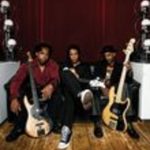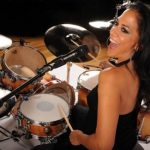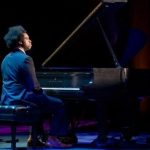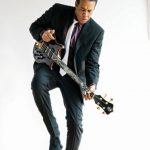
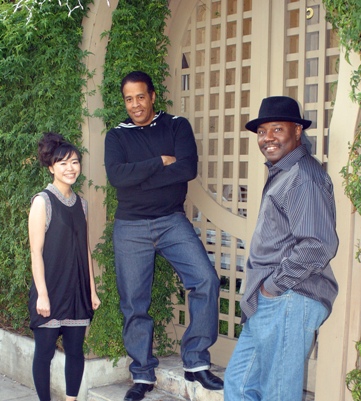
 The Stanley Clarke Trio (l-r): Hiromi, Clarke, Lenny White
Bassist Stanley Clarke was not long out of high school in 1971, when he moved to New York from his native Philadelphia. In the Big Apple, his virtuosic talent made an immediate splash and landed him stints with jazz legends such as Horace Silver and Joe Henderson. But it wasn’t until the following year that Clarke’s career really took off. He joined Return to Forever, the supergroup that included famed keyboardist Chick Corea and Lenny White, the drummer who got Clarke the gig with Henderson. RTF helped pioneer the fusion movement of the ’70s, one of the most adventurous periods in jazz history, in which Clarke also recorded his own fusion classic, the seminal School Days (1976).
Clarke and the late Jaco Pastorius were the most influential electric bassists of that era, in any genre. Though Clarke and his contemporaries became known playing electric jazz, history sometimes overlooks that many of them cut their teeth playing acoustic music.
“When I started recording as a leader, the majority of music I did was electric,” Clarke recently told DCist. “But prior to those early records, all I did was play acoustic bass and acoustic jazz music.”
One need only look to Clarke’s stellar work on saxophonist Stan Getz‘s Captain Marvel (1972) to hear Clarke’s formidable upright chops. Amazingly enough, though he continued to play acoustic bass regularly, Clarke never put out an entirely acoustic album as a leader until this year, which saw the release of Jazz in the Garden. The group featured on this recording will appear in concert tomorrow night at the Barns of Wolf Trap.