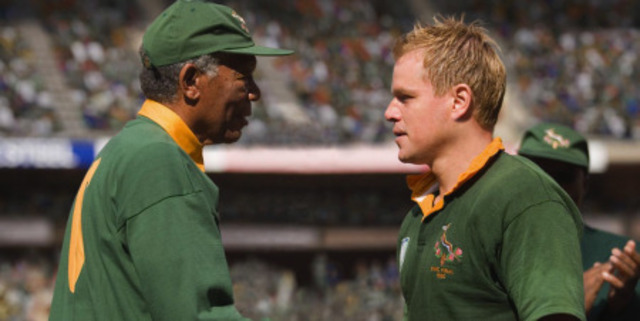
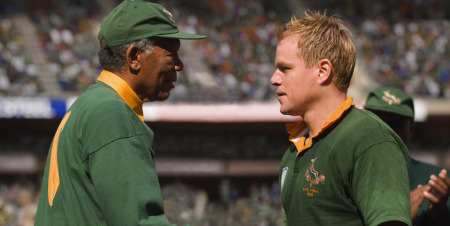
 Morgan Freeman and Matt Damon are great, but Eastwood’s ‘Invictus’ is less than the sum of their parts.
Some movies are impervious to criticism. Their true-life stories are so inspirational, so extraordinary, so much stranger than fiction, that quibbling over the way they’ve been presented doesn’t seem to serve much purpose. Luckily for Clint Eastwood, such stories are also largely impervious to poor storytelling. His Invictus hits all the right formula notes of both the inspiring historical biopic and the underdog sports movie, making it impossible to hate. He also hits those notes so insistently and with such a lack of his usual understated grace that he makes it a difficult movie to really love.
The film opens in 1990, as Nelson Mandela (Morgan Freeman) is being released from prison. The date flashes on the screen, and is followed by a montage of his triumphs of the early ’90s, leading up to his eventual election as president in the first South African elections in which the country’s black population was allowed to vote. Yet the montage is so clumsily constructed by Eastwood and his longtime editors, Joel Cox and Gary Roach, that it appears as if Mandela walked right out of prison and into the presidency.
Despite this early misstep, the film’s strongest moments come early on, as we see the challenges faced by Mandela in assuming power in a government that has been run by the white minority for generations. This is where Eastwood excels, working with actors to create nuanced performances with subtle tension, conveying emotion only hinted at in the script. Freeman is nearly perfect in a role he was meant to play, digging beyond just the physicality of the man, beyond just his movements and his distinctive smile, to the seemingly boundless enthusiasm and energy beneath, which is offset nicely by hints of sadness at the familial problems that plagued Mandela during this time.