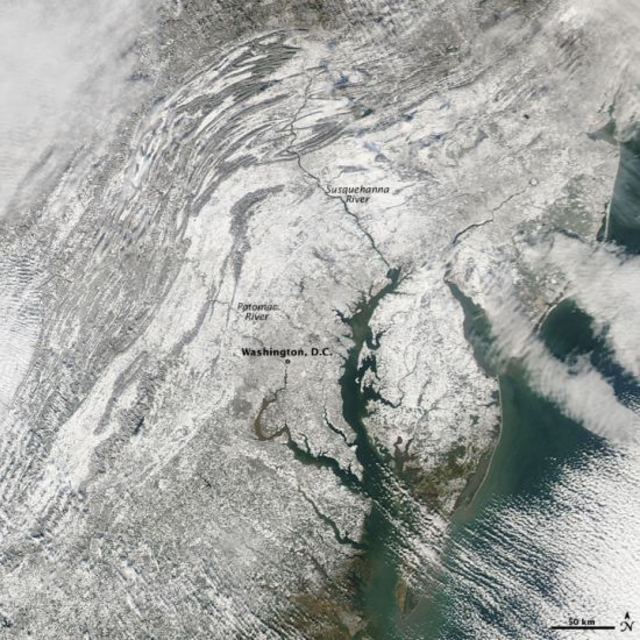
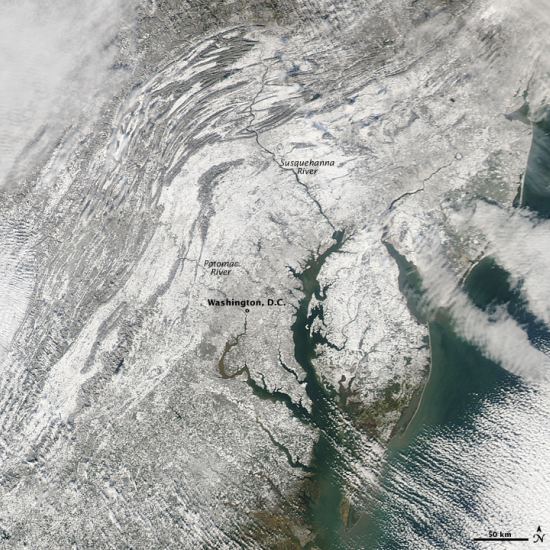
 Image courtesy the NASA Earth Observatory, created by Jesse Allen using data provided courtesy of the MODIS Rapid Response team.
Since the power and/or internet was out at this writer’s house most of the weekend, here’s a special weekday edition of Look Up. Yesterday, of course, was the winter solstice, the shortest day of the year, during which the Earth’s axis is tilted the farthest from the sun. (According to the U.S. Naval Observatory, the exact moment of the solstice occured at 12:47 p.m.) The good news: our days will start to get longer now. The bad news: since the oceans take so long to heat and cool, it will also start to get colder, of course. National Geographic has an excellent article about the astronomy and history of the winter solstice, including how Christians moved Jesus’ birthday celebration to that date to attract pagans to the church (a.k.a. Astronomy’s War on Christmas).
Yesterday we linked to this incredible NASA image seen above of the East Coast snowstorm, but loved it so much we’re posting it again. It was taken by the Moderate Resolution Imaging Spectroradiometer (MODIS) in the Aqua satellite, whose mission is to collect massive amounts of data regarding Earth’s water cycle. Aqua, launched in 2002, is part of a team of satellites that make up the Earth Observing System, designed to study cloud formations, airborne particles, carbon dioxide, ozone and aerosols in the atmosphere. Browse through the collection of Earth Observatory images when you have a chance, many are downright breathtaking.