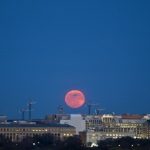
Photo by jbhaber
If the skies clear by tonight, the pathways to our New Year’s Eve parties will be lit by a full Moon, and as only fitting for the last day of the decade, this one is special — a Blue Moon. Popularly, a Blue Moon is known as the second full Moon in the same calendar month (we had one on December 2, as well). Blue Moons occur every few years; the last one was in 1997 and the next will be in 2012.
Of course, that’s not the whole story. I say “popularly” for a reason — the current definition of Blue Moon actually comes from a misinterpretation starting with the Maine Farmers’ Almanac in 1937, which gives the name “Blue Moon” to an extra full Moon in a season. The Farmers’ Almanac used the “tropical year,” which begins not on January 1 but at winter solstice, and followed Gregorian calendar rules which required certain dates to coincide with certain moons (i.e. Harvest Moon). Though each season should have three full moons, every once in awhile a season would have four; the almanac called the third moon out of the four the Blue Moon, which kept the ‘moon schedule’ for the rest of the year.
Sky and Telescope has an excellent article describing the following misinterpretation, particularly since, well, it was their fault. An article by an amateur astronomer in 1946 featured his incorrect definition, that the Blue Moon is the second full Moon in a calendar month, but no one caught it; 35 years later a popular radio program used the Sky and Telescope definition, cementing it into current usage. And in the end, who really cares if our definition has altered? I know my MacBook calendar isn’t synched up to the Harvest Moon, and the story itself is a nice stroll through history. Blue Moons, as we know them, are still a fairly rare occurrence — and the last Blue Moon on New Year’s Eve occurred in 1990 — so let’s just add it to one of the many things we’ll celebrate tonight. In fact, the the Moon demands all kinds of attention tonight — parts of the world (not ours, sadly) will even see a partial lunar eclipse.